
Is Your Supplier Risk Monitoring Working on Bad Data?

If you've recently added a supplier risk monitoring tool, or you're thinking about it, there's a question worth asking before you configure the first alert: What exactly is that tool running against?
For most mid-market teams, the honest answer is: supplier records that were entered manually during onboarding, updated inconsistently since then, and stored across a combination of your ERP, a spreadsheet, and someone's email inbox.
That's not a criticism. It's the reality for the majority of teams managing suppliers without a dedicated supplier data team. But it does mean that the risk scores your monitoring tool produces are only as reliable as the records underneath them. And if those records are incomplete or out of date, your risk program has a problem that no amount of alerting configuration will fix.
What Supplier Risk Monitoring Actually Needs From Your Data
Modern risk monitoring works by matching your supplier records against external data sources — sanctions lists, financial health databases, ESG ratings, adverse news feeds. The matching logic is only as good as what it has to match against.
Here's where mid-market supplier records typically break down:
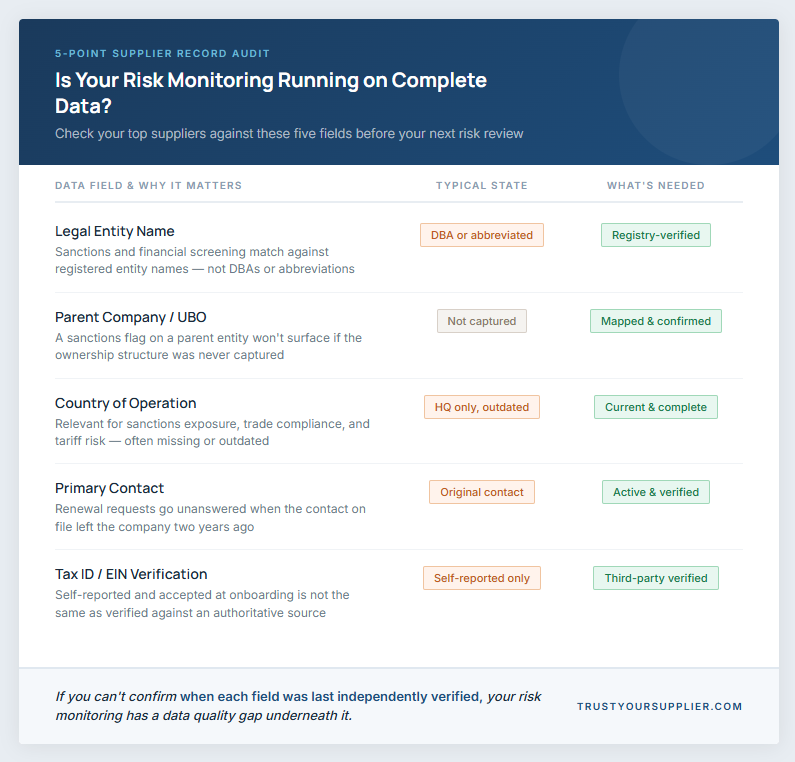
- Legal entity name doesn't match the name used in external databases — because someone entered a DBA name, an abbreviation, or an old name at onboarding
- Parent company and ownership structure were never captured, so a sanctions flag on a parent entity won't surface against a subsidiary in your records
- Address and country of operation are missing or outdated — relevant for sanctions, trade compliance, and tariff exposure
- Primary contact is a person who left the company two years ago, so renewal requests go unanswered, and compliance documents expire
- Tax ID or registration number was never verified against an authoritative source — just entered by the supplier and accepted
None of these gaps will cause your risk tool to throw an error. It will just run its matching logic against incomplete data and return a result. That result may be accurate. It may not be. You often can't tell the difference without digging into the underlying record
The Sequence Problem
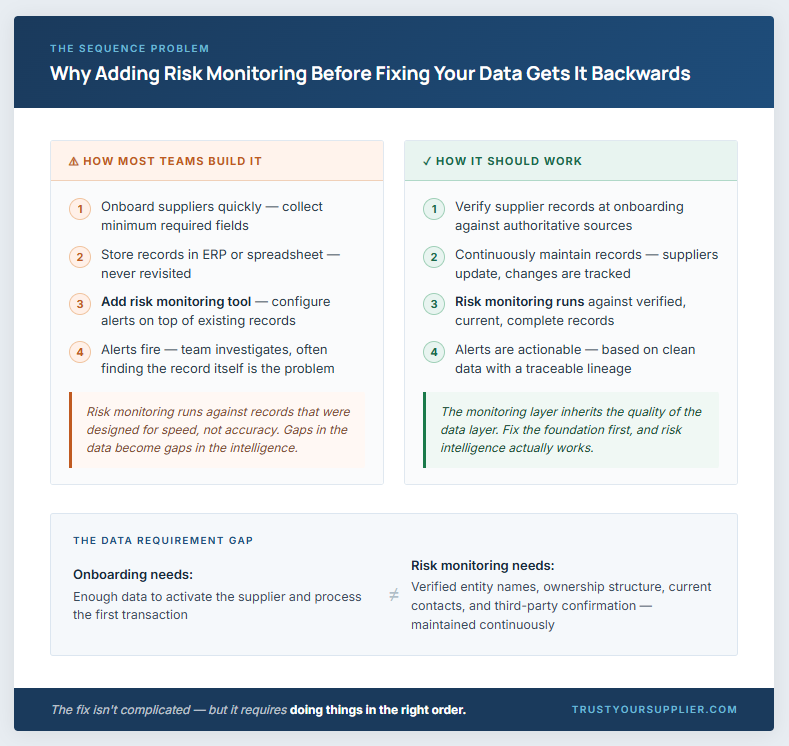
The typical mid-market journey looks like this: team grows, supplier base grows, someone reads about supplier risk and decides to add monitoring, monitoring tool gets configured, alerts start firing. What didn't happen: a review of the supplier records the monitoring is running against.
It's an understandable sequence. The risk conversation tends to happen at the leadership level: "We need better visibility into supplier risk," while the data quality problem lives at the operational level and never gets elevated. So the monitoring layer gets built on top of a data foundation that wasn't designed for it.
The fix isn't complicated, but it does require doing things in the right order.
What to Do Before You Add More Monitoring
A supplier record audit doesn't have to be a six-month project. For most mid-market teams, a focused review of your highest-risk and highest-spend suppliers will surface the most significant gaps quickly. Here's a practical starting point:
- For your top 50 suppliers by spend, verify that the legal entity name in your records matches the name registered with your country's business registry. This single check catches the most common matching failures in sanctions and financial health screening.
- Add parent company and ultimate beneficial owner fields to your records. Even rough data here (publicly available from LinkedIn, Companies House, or D&B) dramatically improves the accuracy of third-party risk matching.
- Check document expiry dates. If compliance certificates, insurance documents, or W-9s have expired and no one noticed, your compliance records are stale by definition. Stale compliance records and stale risk records often go together.
- Flag suppliers with no update activity in the past 12 months. These are your highest data quality risk records, regardless of their risk score.
Quick check: Open your supplier records for your five highest-risk suppliers by score. When was each record last updated? If the answer is "at onboarding," your risk score is running on old data
The Right Architecture: Data Quality and Risk Monitoring Together
The teams that get supplier risk right don't treat data quality and risk monitoring as separate workstreams. They treat them as the same program because the quality of your monitoring is a direct function of the quality of your data.
In practice, this means:
- Supplier records are verified at onboarding against authoritative third-party sources, not just collected from the supplier and accepted
- Records are continuously maintained, not just updated when something breaks
- Suppliers have an incentive to keep their own data current, because their profile serves them across multiple buyer relationships
- The risk score has a data lineage, and you can see what data the score ran against and when it was last verified
This is what Trust Your Supplier (TYS) is built to do. The Trusted Golden Record combines supplier-provided data with third-party verification from Dun & Bradstreet, Moody's, EcoVadis, and other authoritative sources. It's continuously maintained, blockchain-backed so it can't be altered without a trace, and shared across buyer relationships so suppliers have a reason to keep it current.
BT Sourced ran this approach across 2,500+ suppliers and reduced onboarding time by 55% while achieving 85% supplier adoption. The supplier adoption number matters here: when suppliers maintain their own verified record, your data quality problem largely solves itself.
The Question Worth Asking This Week
You don't need a full platform audit to start closing this gap. Pick your ten highest-spend suppliers and ask one question about each: when was this record last independently verified, not just updated by the supplier, but confirmed against an external source?
If you can't answer that question, you have a data quality gap underneath your risk program. And that gap is worth fixing before you add more alerts on top of it.
TYS Essentials gets mid-market teams off spreadsheets and onto a verified, continuously maintained supplier record without a six-month IT project. Starting at $25,000/year for teams managing 500+ suppliers. If your supplier records are overdue for a closer look, we're happy to walk through what verified supplier data actually looks like in practice and whether TYS Essentials is the right fit for your team.