
Why Procurement Decisions Disappear (And What Gartner Says Will Replace Them)

Your supplier risk score was 72. Your team approved them anyway.
Six months later, you're trying to explain the decision to your CFO. You remember there was a reason - a good one. Something about existing contract obligations. Or was it the relationship with another strategic vendor? Maybe it was the timeline pressure from that product launch.
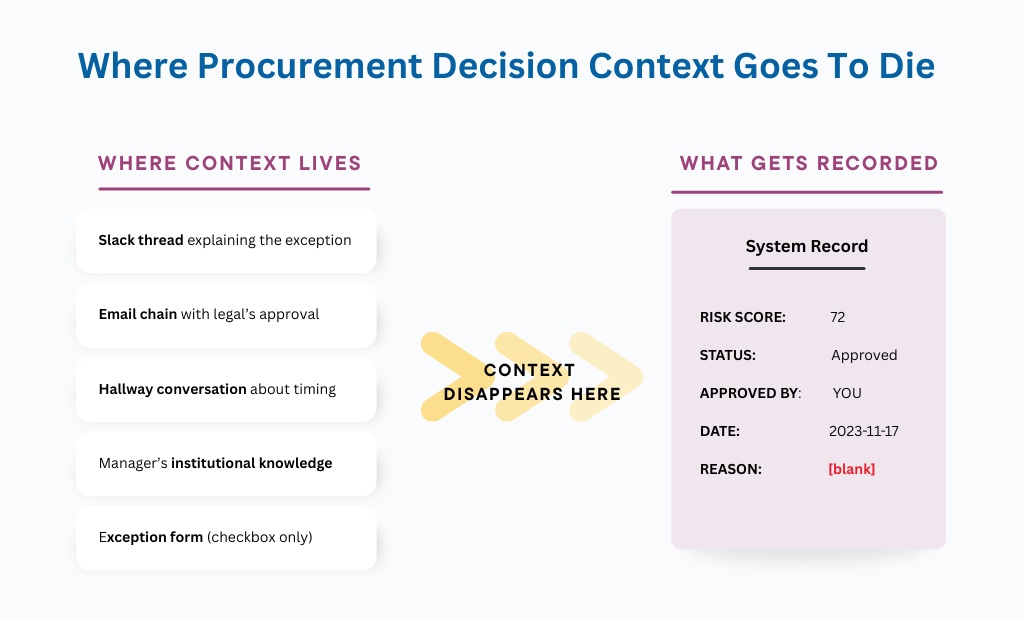
You check the supplier management system. Risk score: 72. Status: Approved. Approved by: You.
That's it. The system captured what happened. But the why, the context, the reasoning, the decision trace, disappeared somewhere between the Slack thread, the hallway conversation, and the final approval click.
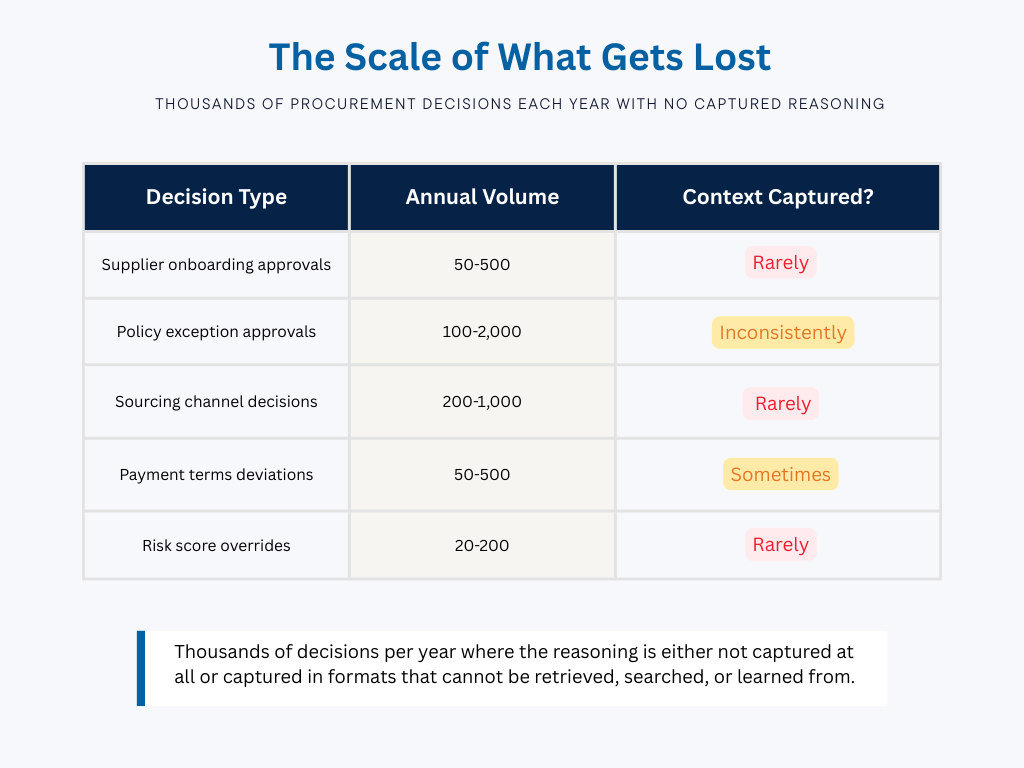
At TYS, we've observed this pattern for almost a decade in procurement organizations. Now industry research is confirming what we've known: this is a category-defining problem. It's happening thousands of times a day. And according to Gartner, it's about to become critical.
The Decision Trace Problem
In January 2026, Gartner published its first Magic Quadrant for Decision Intelligence Platforms. The report includes a stark warning: by 2027, 25% of ungoverned decisions using AI will cause financial or reputational loss.
Why? Because most organizations are rushing to implement AI without solving a more fundamental problem: they're not capturing why decisions get made in the first place.
Gartner calls these "decision traces", the documented reasoning behind choices. In procurement, decision traces live in:
- The Slack thread where your sourcing manager explained why Supplier B was better despite the lower score
- The email where finance approved the exception because of the payment terms
- The hallway conversation where you learned about the supplier's performance on a sister project
- The tribal knowledge in your procurement veteran's head about which suppliers actually deliver
By the time data reaches your data warehouse or analytics platform, these decision traces are gone. You have the outcome (Approved: Yes) but not the reasoning (Approved: Because...).
And that reasoning is the difference between data and intelligence.
From Data-Driven to Decision-Centric
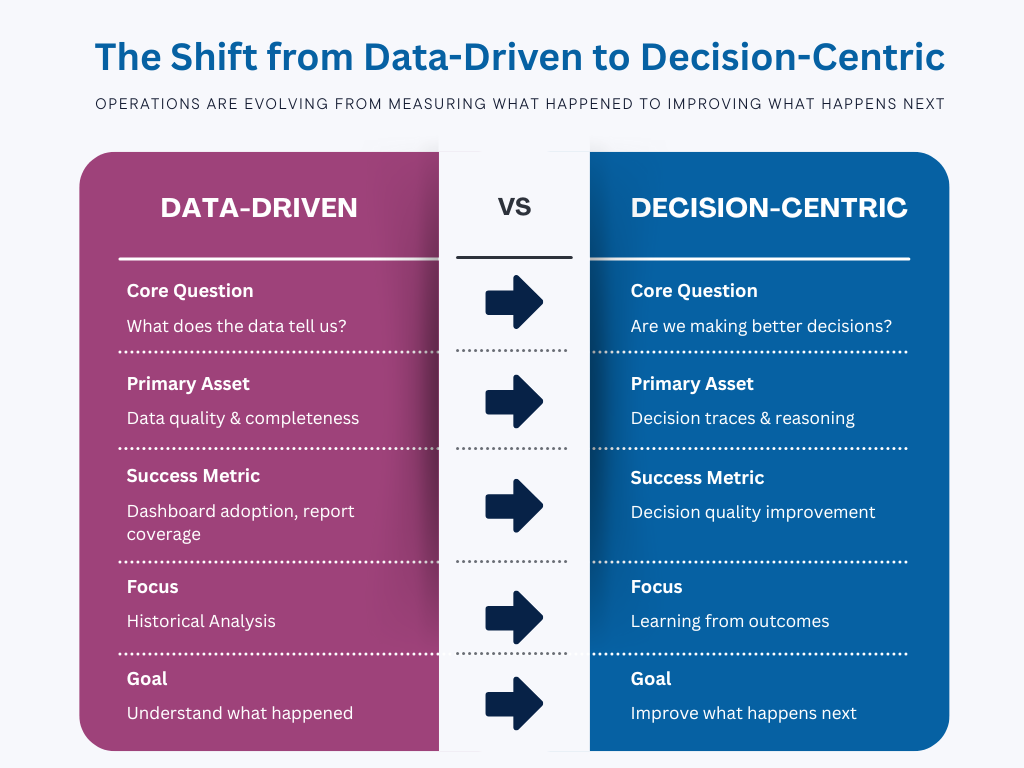
Gartner predicts that by 2028, 25% of CDAO vision statements will become "decision-centric," surpassing "data-driven" slogans.
This isn't just semantic rebranding. It's a fundamental shift in how organizations think about data and analytics.
Data-driven thinking asks: "What does the data tell us?"
Decision-centric thinking asks: "What decisions do we need to make, and what traces of past decisions can inform them?"
The difference matters because, as PK Sridhar (TYS Head of Product) puts it:
"Procurement is fundamentally nothing but a collection of decisions happening at scale. You need to improve the quality, speed, and time of those decisions."
You can't improve what you don't capture. And right now, most procurement organizations are capturing outcomes without context.
What Is Decision Intelligence?
Gartner defines Decision Intelligence Platforms (DIPs) as software that enables organizations to "explicitly model decisions, orchestrate decision flow during execution at scale, and enable monitoring and governance of decision quality, while learning from actions and outcomes."
Notice what's missing: any mention of AI, machine learning, or automation as the starting point.
The foundation of decision intelligence isn't artificial intelligence. It’s explicit decision modeling. Capturing not just what you decided, but why you decided it.
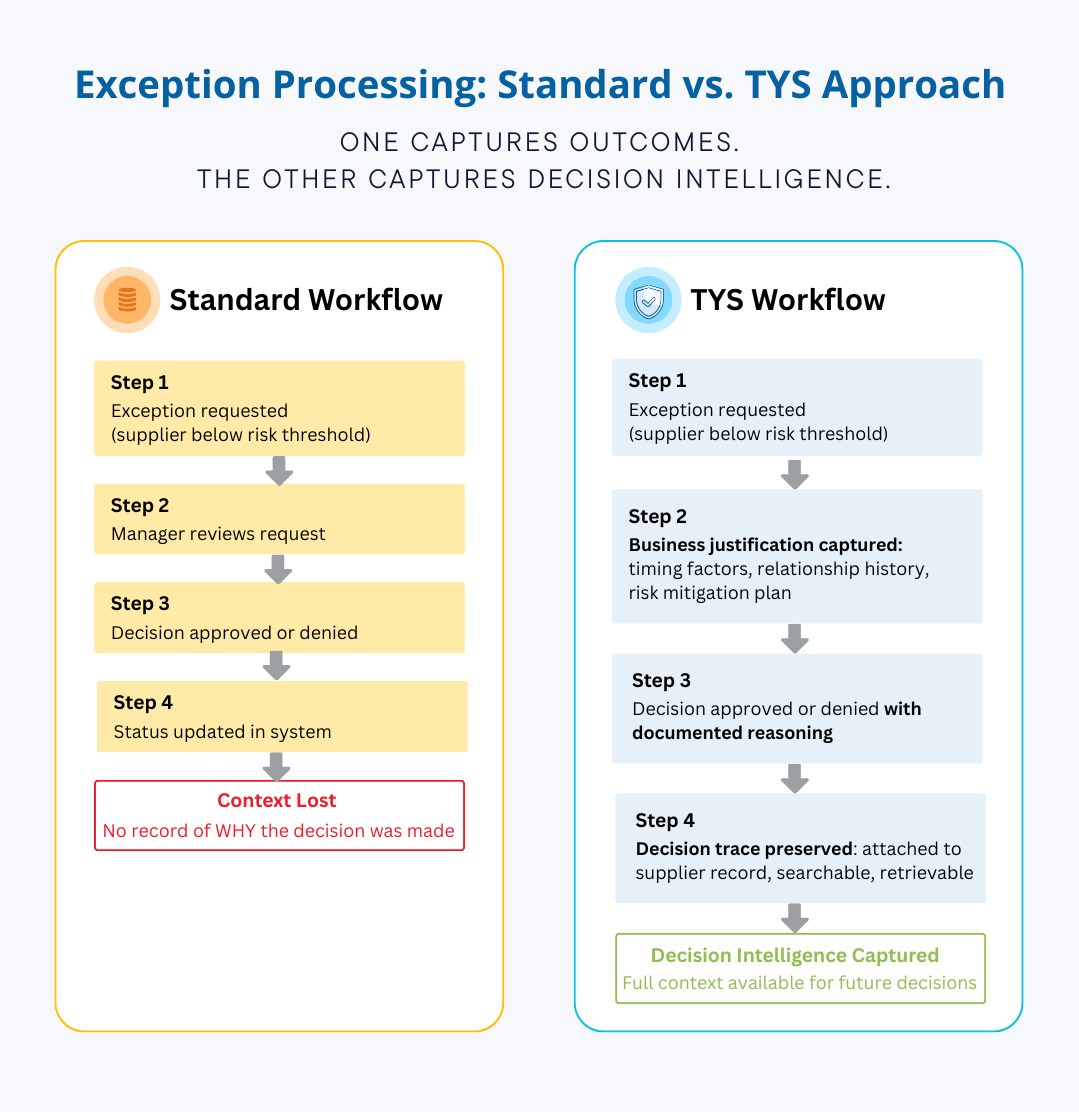
Think about your exception processing workflows. When someone requests approval to:
- Onboard a supplier below the risk threshold
- Extend payment terms beyond policy
- Sole-source instead of competitive bid
- Waive an insurance requirement
What happens to the reasoning? In most organizations:
- Requester explains in email or form
- Approver reviews and makes judgment
- Decision is recorded as: Approved/Denied
- The reasoning evaporates
That reasoning, that decision trace, is organizational intelligence. It contains:
- Risk assessments that automated scores miss
- Business context that policies can't encode
- Relationship dynamics that data doesn't capture
- Judgment calls that improve with experience
This is the gold mine. And it's disappearing.
The Procurement Gap
Here's what's interesting: Gartner evaluated 17 Decision Intelligence Platforms in their inaugural Magic Quadrant. These vendors serve:
- Banking and investment services
- Insurance
- Healthcare
- Manufacturing and natural resources
- Government
- Retail
- Supply chain operations (one vendor, o9 Solutions)
None focuses specifically on procurement or supplier management decisions.
This is a significant white space. While horizontal DIPs like FICO, IBM, and SAS provide powerful capabilities, they require heavy customization for procurement use cases. The decision flows, risk factors, policy frameworks, and exception patterns in procurement are unique.
Consider what procurement-specific decision intelligence would need to understand:
- Supplier relationship dynamics and history
- Category-specific risk profiles
- Regulatory requirements by region and industry
- Policy exceptions and their business rationale
- Cross-functional approval patterns
- Market conditions and urgency factors
Generic decision intelligence platforms can provide the infrastructure. But procurement needs vertical-specific intelligence.
Why This Matters Now (And What to Do About It)
Gartner predicts that by 2030, explicitly modeled business decisions will be five times more trusted and 80% faster than ungoverned decisions.
Let that sink in: 5x more trusted. 80% faster.
The organizations that start capturing decision traces today will have years of rich context data when decision intelligence capabilities mature. The organizations that wait will be starting from zero.
So what should procurement leaders do?
-
Start Documenting Decision Traces
Look at your exception processing workflows. These are already decision traces, moments when the standard policy doesn't apply and judgment is required.
Are you capturing:
- The business context for the exception?
- The risk mitigation measures implemented?
- The outcome of the decision?
- What you learned?
If your exception approval process results in "Approved" or "Denied" without the reasoning, you're losing intelligence.
-
Recognize Policy Evolution Signals
When you approve 10 exceptions to the same policy in three months, that's not a failure of compliance. It's a signal that the policy needs to evolve.
Decision traces let you identify these patterns. They're the feedback loop between "how we thought things should work" and "how they actually work in the real world."
-
Build Governance Before Automation
Gartner's warning about ungoverned AI decisions isn't theoretical. As LLMs and AI agents become embedded in procurement workflows, organizations without decision governance frameworks will face:
- Unexplainable decisions that can't pass an audit
- Biased outcomes they can't detect or correct
- Compliance failures they didn't know were happening
- Eroded trust in automated recommendations
Decision governance, the ability to log, audit, and explain every decision, needs to come before decision automation.
-
Think About the Next Marginal Decision
The real value of decision traces isn't historical analysis. It's improving the next decision.
When a similar situation arises, another supplier with a low score but strong business case, what if the system could surface:
- How you handled the last three similar cases
- What reasoning you accepted or rejected
- What outcomes resulted from those decisions
- What risk mitigation worked or didn't
This is where decision traces become decision intelligence.
Where TYS Fits (And Where We're Going)
Full transparency: TYS isn't a Decision Intelligence Platform by Gartner's definition. Not yet.
But we do something that most procurement platforms don't: we capture decision traces.
Through our exception processing and approval workflows, we document:
- Why supplier decisions were made
- What factors influenced the judgment
- Who approved and why
- What the outcome was
We've been doing this for almost a decade. Our customers have years of decision trace data that other platforms have lost.
What we're building is the intelligence layer on top of that foundation. The ability to:
- Identify patterns in exception approvals
- Surface similar historical decisions when new ones arise
- Learn which risk factors matter vs. which don't
- Suggest policy updates based on actual decision patterns
TYS has been capturing decision traces through exception processing since 2018, long before Gartner formalized "Decision Intelligence Platforms" as a category. We have the foundation. Gartner's framework gives it a name and validates the direction we've been building toward.
As our Head of Product puts it:
"We manage decisions and document decisions today. Our opportunity is to use those traces to improve the next marginal decision. That's where the real value is."
The Bottom Line
Procurement organizations face a choice:
Continue letting decision traces evaporate into Slack threads and tribal knowledge, or start explicitly capturing them as organizational assets.
The technology for full decision intelligence, AI-driven recommendations, automated policy updates, and autonomous decision flows is still maturing. But the foundation you need to capture today is simply this:
Document why decisions happen, not just what happened.
When you approve a risky supplier, capture the reasoning.
When you make an exception to policy, document the business context.
When judgment overrides the score, explain the factors.
These decision traces are the fuel for tomorrow's decision intelligence. The organizations capturing them now will be years ahead.
By 2028, when your vision statement shifts from "data-driven" to "decision-centric," you'll be grateful you started documenting the why.
What's Next?
If you're thinking about decision intelligence for your procurement organization, we'd love to talk. Not to pitch TYS (though we're happy to demo if it makes sense), but to share what we're learning from organizations capturing decision traces.
Book a 30-minute conversation to discuss:
- How decision intelligence applies to your procurement challenges
- What decision traces you're already capturing (or losing)
- Where the Gartner framework suggests you focus
- How other procurement teams are thinking about this shift
*This analysis references findings from Gartner's Magic Quadrant for Decision Intelligence Platforms (January 2026, ID G00827619), a licensed reprint.