
What Actually Needs to Happen When a Supplier Relationship Ends

Most procurement teams have a supplier or vendor onboarding process. It might not be perfect, but it exists. There are steps, there are approvals, and there is someone responsible for getting a new supplier into the system.
The same is rarely true for offboarding.
When a supplier relationship ends (contract not renewed, business unit moving to a different vendor, supplier failing a compliance review), the response in most organizations is some version of notifying the relevant people, closing the contract, and moving on. The formal steps that should follow rarely happen in any structured way.
That gap creates real exposure. Not in a theoretical, something-might-happen-someday way. In a concrete, here-are-four-things-that-are-still-active-right-now way.
This post walks through what a complete supplier offboarding process actually looks like, why skipping it creates audit risk, and a simple checklist your team can use to close the loop properly every time.
Why Offboarding Gets Skipped
The reason most teams don't have a formal offboarding process isn't negligence. It's other priorities.
Onboarding has urgency built into it. A business unit is waiting on a supplier. Someone is tracking the timeline. There is pressure to move quickly and do it right.
Offboarding has none of that. The relationship is over. No one is waiting on anything. The contract is done. From a day-to-day operations standpoint, it feels finished.
The problem is that "done" from a business perspective and "done" from a compliance and security perspective are two different things. The contract ends. The exposure doesn't, at least not automatically, and not unless someone takes specific steps to close it.
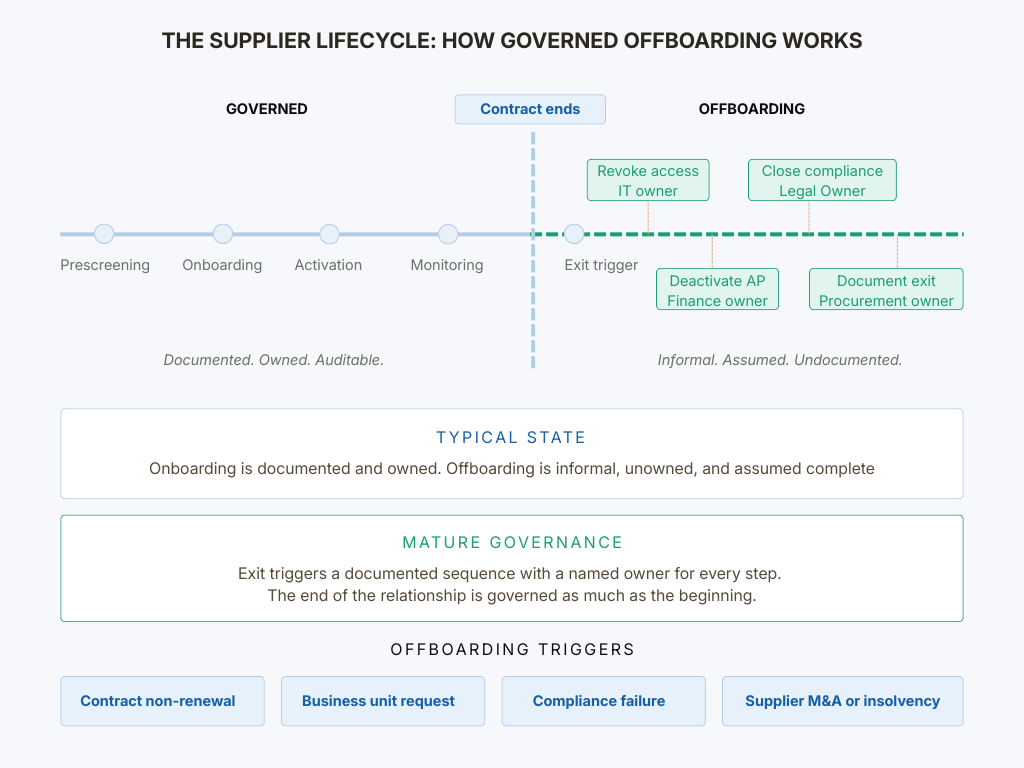
Six Things That Need to Happen When a Supplier Relationship Ends
-
Revoke System Access
If your suppliers have portal access, login credentials, or any kind of integration into your systems, those access points need to be explicitly closed when the relationship ends. They do not close automatically.
A dormant supplier account with active credentials is a security exposure. This is not hypothetical; it is a standing condition that persists until someone actively shuts it down. The first step in any offboarding process should be a clear owner responsible for access revocation, confirmed in writing.
-
Remove or Archive the AP Record
Accounts payable records for a terminated supplier, including bank account details, remain active in most systems until manually deactivated. An unremoved vendor bank record is one of the most common vectors for payment redirection fraud. Criminals specifically target dormant vendor accounts because organizations are not actively monitoring them after contract end.
Supplier offboarding must include a formal step where AP is notified and the vendor record is either deactivated or flagged as terminated. This is not optional and it is not a step that happens automatically.
-
Formally Close the Compliance Record
Contracts that end without documented closure create ambiguity in your audit trail. When did the relationship end? Who authorized termination? Were outstanding compliance obligations (certifications, insurance, data handling) resolved before exit?
If an auditor asks about a supplier that exited your program two years ago, the question is not whether you have a termination policy. The question is whether you can show the documentation that proves the policy was followed for that specific supplier. A formally closed compliance record, with reason for exit, authorization chain, and status change, is what answers that question.
-
Confirm Data Obligations Are Resolved
Depending on your contracts and your data privacy obligations, a terminated supplier may have held data about your organization, your operations, or your customers. If your offboarding process does not include a step to confirm data return or destruction, that obligation goes unverified indefinitely.
This is particularly relevant for technology vendors and any supplier who had access to sensitive operational data. Before a relationship closes, confirm what data obligations exist under the contract and document that they were fulfilled.
-
Notify Internal Stakeholders
The business unit that used the supplier knows the relationship is ending. Procurement knows. But does IT know to revoke access? Does Finance know to deactivate the AP record? Does Legal know the contract is closed and can be filed?
Offboarding without a formal internal notification step leaves cleanup tasks sitting in a grey area where everyone assumes someone else has handled it. A simple notification process, triggered at contract end and sent to every relevant internal team with their specific action, closes that grey area.
-
Document the Reason for Exit
Why a supplier relationship ends matters. A supplier who failed a compliance review should be flagged differently than one whose contract simply wasn't renewed. A supplier terminated for performance issues should be documented as such before a different business unit tries to onboard them again.
Exit documentation protects your organization in two directions: backward (audit trail) and forward (institutional memory). If the same supplier appears in a future onboarding request, the team evaluating them should be able to see the history. That only happens if the reason for exit is formally recorded.
The Audit Risk of Skipping These Steps
Each of the six steps above has a corresponding audit risk if it's skipped. Access not revoked means a potential security finding. AP record not deactivated means a fraud control gap. Compliance record not closed means an ambiguous audit trail. Data obligation unconfirmed means a potential privacy compliance issue. Internal stakeholders not notified means tasks go undone. Exit reason undocumented means institutional memory is lost.
Individually, any one of these is manageable. Collectively, and in most organizations all six are skipped routinely, they represent a pattern that auditors recognize: a procurement function that manages supplier relationships but not supplier exits.
The good news is that none of these steps is particularly complex. The challenge is not the complexity of the steps. It is building a process that ensures they happen every time, for every supplier, regardless of who is managing the exit or how busy the team is.
A Simple Supplier Offboarding Checklist
Use this as a starting point. Adapt it to your organization's systems and compliance requirements.
When a supplier relationship ends, confirm each of the following before closing the record:
- [ ] System access credentials identified and revoked
- [ ] AP vendor record deactivated or flagged as terminated
- [ ] Contract status formally closed with documented authorization
- [ ] Outstanding compliance obligations confirmed as resolved
- [ ] Data return or destruction obligation confirmed per contract terms
- [ ] Internal stakeholders notified: IT, Finance, Legal, relevant business unit
- [ ] Reason for exit documented in the supplier record
- [ ] Supplier status updated in your supplier management system
The goal is not a perfect process on day one. The goal is a consistent process, one where the same steps happen for every supplier exit, someone owns each step, and the documentation exists to prove it.
What This Looks Like When It's Working
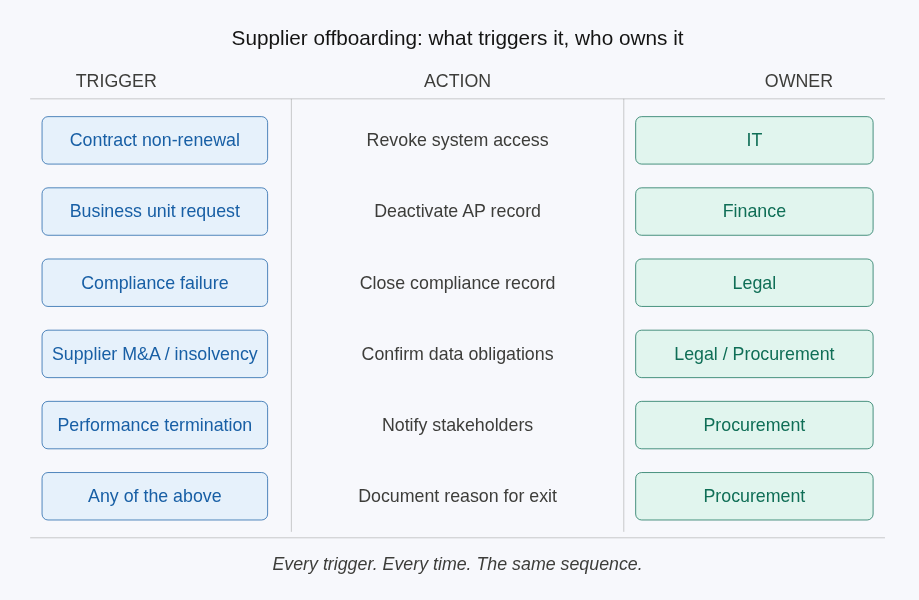
Organizations with mature offboarding processes typically have two things in place that most growing teams don't: a trigger and an owner.
The trigger is the event that starts the offboarding sequence. It might be a contract expiration date, a termination notice from a business unit, or a compliance disqualification. Whatever the trigger, it should automatically initiate the same checklist every time, not depend on someone remembering to start it.
The owner is the person accountable for making sure every step on that checklist is completed and documented. Not vaguely responsible. Accountable in the sense that if an auditor asks whether the offboarding checklist was completed for a supplier who exited eighteen months ago, there is a name and a record.
If your team has both of these, a clear trigger and a named owner, your offboarding process is in better shape than most. If you're missing one or both, that is the place to start.
The Bigger Picture
Supplier risk doesn't only live in the onboarding process. It lives across the entire lifecycle, including the end of it.
The organizations that build strong supplier programs treat offboarding as part of the same governance framework as onboarding. The entry is documented. The relationship is monitored. The exit is closed properly. Every step is connected.
If your team has invested in getting onboarding right, it's worth spending the same attention on getting offboarding right. The exposure that accumulates in an unmanaged exit can undo a lot of the work that went into a well-managed entry.
Trust Your Supplier helps growing procurement teams manage the full supplier lifecycle, from onboarding through offboarding. If you're building out your supplier exit process and want to see how other teams are approaching it, we'd love to talk. Get in touch →