
Why Your ERP’s Vendor Module Isn’t Enough (And What to Use Instead)

Most procurement teams don't set out to build a broken supplier management process. They build what makes sense at the time. The ERP is already there. It has a vendor module. Someone figures out how to use it, trains the team, and moves on.
For a while, it works.
Then the supplier base grows. Compliance requirements multiply. An auditor asks for documentation that nobody can find. A certificate expires and nobody noticed. A new hire can't figure out where anything is because the process lives in the institutional memory of the person who built it three years ago.
This is not a people problem. It is an architecture problem. And it starts with a reasonable but incorrect assumption: that an ERP's vendor module is a supplier management system.
It isn't. Here's why that matters, and what to do about it.
What ERP Vendor Modules Were Built to Do
Enterprise resource planning systems are transaction engines. They were designed to track purchase orders, process invoices, manage payments, and give finance a clean record of what was spent and with whom.
The vendor module exists to support that transaction workflow. It stores a supplier's name, address, bank details, and tax information. It connects to the AP process so invoices can be matched to approved vendors. It does what it was designed to do, and it does it reasonably well.
The problem is what it doesn't do and what teams assume it does when it doesn't.
Where the Gaps Show Up
- Compliance documentation management
An ERP can store a document. It cannot track that document's expiry date, send automated renewal reminders, route expired certificates to the right person for follow-up, or flag a supplier as non-compliant when their insurance lapses.In practice, this means someone on your team is manually checking expiry dates on a spreadsheet. Or nobody is, until an auditor asks.
- Risk monitoring
ERP vendor modules capture static data. Supplier risk is not static. A supplier's financial health, ownership structure, sanctions status, and ESG posture change. The vendor record in your ERP captures a snapshot at the time of onboarding. It does not tell you what changed last month.Continuous risk monitoring requires a system built for monitoring. An ERP vendor module was not.
- Onboarding workflow
Getting a new supplier into your ERP typically involves a combination of email requests, PDF forms, manual data entry, and back-and-forth to collect missing information. There is no structured workflow. There is no supplier-facing portal with a clear checklist. There is no automated validation to catch errors before they become problems downstream.The result: onboarding takes weeks when it could take days, and the data quality at the end of that process is inconsistent.
- Cross-functional visibility
Procurement knows which suppliers are active. Finance knows who gets paid. Legal has signed contracts somewhere. Risk and compliance have a spreadsheet of certifications. IT has vendor security assessments in a shared drive. None of these systems talk to each other. Nobody has a complete picture of any given supplier relationship. When something goes wrong, such as a compliance failure, a fraud attempt, or an audit request, piecing together the full picture is a manual, time-consuming process.
ERP vendor modules do not solve this. They are one data point among many disconnected ones.

The Audit Moment
Here is the scenario that makes this concrete.
An auditor asks for evidence that all active suppliers have current certificates of insurance and valid W-9s on file. They want the documentation for every supplier in a specific spend category, and they want it within 48 hours.
If your supplier data lives in your ERP vendor module, supplemented by certificates in email threads and a spreadsheet someone maintains in their spare time, the next 48 hours will be miserable. People will be pulling files, chasing suppliers for documents they swear they sent, and hoping the final package is complete enough.
If your supplier data lives in a purpose-built system with compliance document tracking, automated renewal workflows, and a centralized audit trail, you pull a report and send it.
The difference is not effort. The difference is architecture.
What "Good" Looks Like
A purpose-built supplier management system does several things an ERP vendor module cannot.
It manages the full lifecycle. Supplier relationships do not begin at the first invoice. They begin when a supplier is identified, screened, and selected. They do not end at the last payment. They end when the relationship is formally offboarded and the record is closed. ERP vendor modules cover the middle. They miss the beginning and the end, which is where much of the compliance and governance risk lives.
It tracks document compliance automatically. Certificates, licenses, insurance policies, and regulatory filings all have expiry dates. A purpose-built system tracks them, sends reminders to suppliers, and alerts your team when something lapses. The process runs without anyone managing a spreadsheet.
It provides a verified, single supplier record. Not a data entry in one system and a different entry in another. A single, enriched record that pulls together self-reported supplier information, third-party validation, and continuous risk monitoring. When someone on your team needs information about a supplier, they go to one place.
It integrates with your ERP. This is the point most teams miss. Replacing your ERP is not the answer. Adding a governance layer that sits alongside it is. Supplier data flows from the supplier management system into your ERP for transaction processing. The ERP does what it's good at. The supplier management system does what it's good at. They work together.
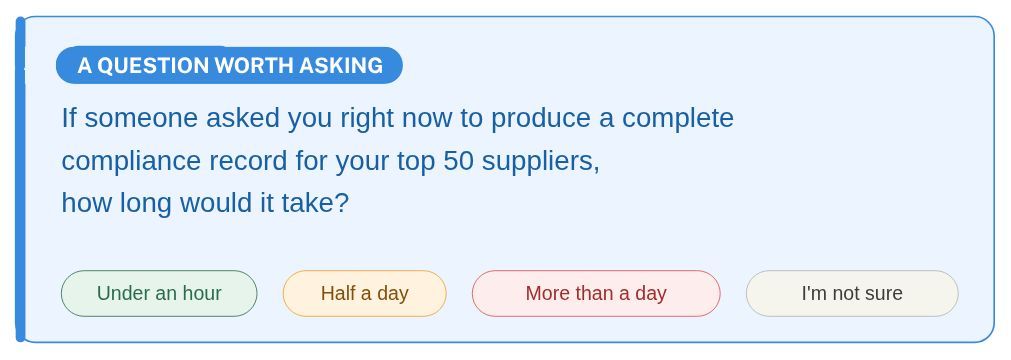
A Question Worth Asking
If someone asked you right now to produce a complete, current compliance record for your top 50 suppliers, how long would it take?
If the honest answer is "more than a day" or "I'm not sure," that's the gap in concrete terms. Not a technology gap. A process gap enabled by the wrong technology for the job.
The Mid-Market Reality
The instinct in mid-market organizations is to wait. To assume that specialized supplier management systems are for large enterprises with large procurement teams and large IT budgets.
That instinct is increasingly expensive.
Compliance obligations for mid-market companies have grown substantially in the last five years. ESG requirements, data privacy regulations, sanctions screening, and fraud controls apply regardless of company size. The risk of a compliance failure, a successful fraud attempt, or a failed audit is not proportional to headcount.
Purpose-built supplier management tools built for mid-market teams are now available at a price point and deployment complexity that makes them accessible without a six-month implementation project. The barrier is lower than most teams assume.
The question is not whether your organization is big enough for a real supplier management system. The question is whether your current architecture is creating risk you're not aware of.
What to Do Next
Start with an honest assessment of where your process breaks down. A few useful questions:
- How long does it take to onboard a new supplier from initial contact to first invoice?
- How are you tracking compliance document expiry dates today?
- When was the last time you reviewed your full supplier list for inactive or off-boarded vendors still in your system?
- If you had to produce a complete compliance file for a specific supplier today, where would you go first?
The answers usually make the gap clear on their own.
If you want to see what a purpose-built system looks like in practice for a team your size, we'd be glad to show you how TYS works.