
Growing Into New Markets? Here’s What Happens to Your Supplier Compliance Program.

Most companies don't discover their supplier compliance program has geographic limits until they're already operating in a new country.
By then, the suppliers are onboarded, the contracts are signed, the relationships are running, and a regulation the team didn't know applied to them is already in effect.
This is one of the most consistent patterns in global supplier management: compliance programs are built for the environment they're born in. When that environment changes, the program doesn't automatically change with it.
The Problem Isn't Intent. It's Architecture.
A procurement team managing 400 suppliers across one country has, over time, built processes that work for that context. Questionnaires written for local labor law. Onboarding workflows tuned to domestic banking requirements. Risk monitoring calibrated to the regulatory landscape they know.
When that same team enters a second country, the instinct is to extend what already works. Apply the same questionnaire. Use the same onboarding process. Route new suppliers through the same approval chain.
What they don't always account for: the regulatory obligations don't transfer. New jurisdictions bring new requirements, and many of them have no equivalent in domestic programs.
The Compliance Obligations That Catch Teams Off Guard
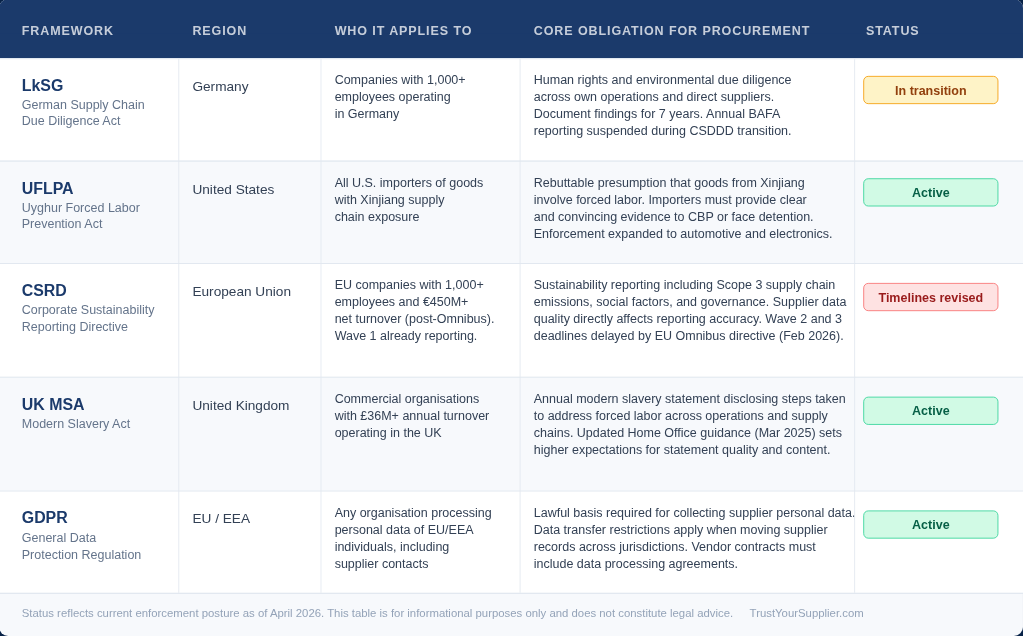
These are the frameworks that most frequently surprise organizations when they expand their supplier base internationally:
Germany's LkSG (Supply Chain Due Diligence Act) In effect since 2023, LkSG requires German companies above certain thresholds to conduct human rights and environmental due diligence across their supply chains, including direct and, in some cases, indirect suppliers. It applies to the German entity, but the compliance obligation extends to suppliers regardless of where they operate. Non-compliance carries significant fines.
Note: Germany is in the process of transitioning LkSG to align with the EU's CSDDD. Annual reporting to BAFA has been suspended, and enforcement has narrowed to serious violations. The underlying due diligence obligations (risk management, supplier assessment, documentation) remain in force.
UFLPA (Uyghur Forced Labor Prevention Act) U.S. importers are subject to a rebuttable presumption that goods produced in Xinjiang involve forced labor. The burden of proof sits with the importer, not the regulator. For organizations sourcing any goods with even partial supply chain exposure to that region, the documentation requirements are substantial and ongoing.
CSRD (Corporate Sustainability Reporting Directive) The CSRD requires EU companies to report on sustainability matters, including supply chain impacts covering Scope 3 emissions, social factors, and governance across the supplier network. For procurement, this means supplier data quality is no longer just an operational concern. It's a reporting one. The regulation has been in flux. The EU Omnibus directive, finalized in February 2026, narrowed the scope of companies subject to mandatory reporting and adjusted timelines for Wave 2 and Wave 3 entities. Large organizations with 1,000-plus employees and significant EU operations remain in scope. Regardless of where a specific company lands on the reporting threshold, the data infrastructure question doesn't change: if you supply into the EU, your customers may ask for it even if regulators don't require it yet.
Modern Slavery Acts (UK and Australia) Both the UK Modern Slavery Act and Australia's Modern Slavery Act require organizations to report on the steps taken to address modern slavery risk in their operations and supply chains. The reporting obligation applies regardless of where your suppliers are based. A company headquartered in the U.S. with a UK subsidiary can find itself subject to UK reporting requirements through that entity.
GDPR Data privacy in the supplier relationship is often treated as a procurement afterthought. It shouldn't be. If you're collecting supplier data from EU-based entities, processing it through cloud-based tools, or transferring it across jurisdictions, GDPR considerations apply to how that data is handled, stored, and shared.
Why Extending Your Domestic Program Doesn't Work
The structure that works at 400 domestic suppliers usually breaks at 800 suppliers across four countries, for a few practical reasons.
Questionnaires don't localize well. A human rights questionnaire written for suppliers in the United States asks different questions than one written to satisfy LkSG requirements or UK Modern Slavery Act reporting. Running the same questionnaire across all supplier populations means the data you're collecting doesn't match what regulators are asking for.
Risk scoring doesn't account for jurisdiction. A supplier's risk profile in Germany includes factors that don't appear in a domestic risk model: specific labor law obligations, environmental due diligence standards, and human rights documentation requirements. If your risk scoring was calibrated for domestic compliance, it may not surface the right signals in an international context.
Workflows weren't designed for cross-functional alignment. International compliance typically requires coordination between procurement, legal, compliance, and sometimes finance. If your onboarding and monitoring workflows were built for a domestic procurement team, the handoffs don't exist, and compliance gaps open up between functions.
What to Put in Place Before You Expand
Getting ahead of international compliance doesn't require a wholesale redesign of your supplier management program. It requires treating compliance requirements as a variable, not a constant.
A few things that matter before international expansion rather than after:
Map the regulatory landscape by jurisdiction. Before onboarding suppliers in a new country, identify what compliance obligations apply to your organization as a buyer, to your suppliers as vendors, and at the supply chain level. LkSG, UFLPA, CSRD, and modern slavery obligations each have different scopes. Knowing which applies to your specific situation takes a few hours. Discovering them after an audit does not.
Review your questionnaire coverage by regulation. If you're using a single supplier questionnaire globally, check whether it covers the specific data points each regulation requires. In many cases, dedicated questionnaire modules by regulatory framework are more manageable than a single questionnaire trying to satisfy everything.
Build jurisdiction into your risk model. The country a supplier operates in should affect how you assess them. Suppliers in high-risk regions for forced labor, suppliers subject to specific environmental due diligence obligations, and suppliers with documented human rights exposure all carry regulatory risk that a generic risk score may not reflect.
Think about data infrastructure before you think about geography. International compliance requires accurate, verified supplier data. Country of origin, sub-tier relationships, certification status, and regulatory classification all need to be reliable before they can support reporting obligations. Organizations that try to build international compliance programs on top of incomplete supplier records find the data problem before they find the compliance answer.
The Suppliers You Onboard Today Set Your Compliance Baseline for Years
The data captured at onboarding travels with a supplier for the life of the relationship. A supplier profile that's missing country-of-origin detail, lacks certification documentation, or contains unverified entity information doesn't just create a gap at onboarding. It creates a gap in every risk assessment, compliance report, and audit response that comes after it.
International expansion is a good moment to ask whether the supplier data foundation you're building on is actually ready for the compliance obligations that come with it.
If it's not, that's a solvable problem. But it's much easier to solve before you're managing suppliers across five jurisdictions than after.
TYS helps procurement and compliance teams manage supplier risk across multiple countries and regulatory frameworks, without rebuilding your program for every new market. Learn how TYS handles risk and compliance.