
Your Manual Onboarding Process Is Quietly Corrupting Your Supplier Data

When a supplier gets approved and moves into your ERP, it feels like the work is done. The onboarding checklist is complete. The vendor is active. The business can move forward.
But for most teams running manual onboarding processes, that moment of approval is also the moment a data quality problem gets locked in.
Not a visible problem. Not a problem anyone will notice this week. A slow problem. One that compounds quietly across every supplier you add, every manual step your team takes, and every month that passes before an audit, a fraud incident, or a compliance failure makes the cost impossible to ignore.
Manual onboarding doesn't just slow your team down. It corrupts supplier data at the source. And that corruption follows your suppliers for the life of the relationship.
The Problem Isn't Speed. It's Data Integrity.
Most conversations about slow supplier onboarding focus on the wrong metric. Reducing the time-to-approve matters. But a faster bad process just means you get to the data quality problem sooner.
Every manual step in a supplier onboarding workflow is a point of failure: a field left blank because no one followed up, a document accepted at face value because there was no verification step, a bank account entered by hand and never confirmed, a compliance certificate uploaded once and never tracked for expiry.
None of these errors announce themselves. They sit in your supplier records, waiting.
The teams that discover the cost of manual onboarding are the ones facing an audit that takes four weeks of document hunting instead of four hours. Or a fraud incident that originated with unverified bank details. Or a compliance gap that existed for 18 months before anyone noticed.
By then, the damage isn't isolated to one supplier. It's systemic.
Where Manual Onboarding Creates the Most Risk
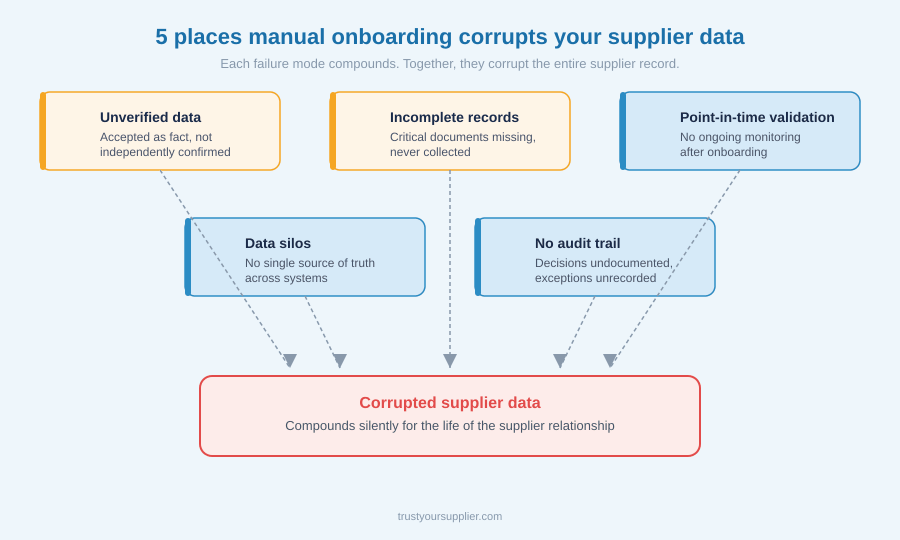
These are the failure points that show up most consistently in manual onboarding processes. Each one creates a downstream risk that teams rarely trace back to its origin.
1. Unverified data accepted as fact
When suppliers self-report their information and no one independently verifies it, you don't have supplier data. You have supplier claims. Bank account numbers entered by the supplier with no validation step. Tax IDs typed in and assumed correct. Business addresses listed without confirmation they're real. Certifications attached without checking the issuing authority.
Self-reported data creates two distinct risks: honest errors and deliberate fraud. Both are preventable. Neither gets caught without a verification step.
2. Incomplete records treated as complete
In manual workflows, the path of least resistance is approval. The business needs the supplier live. The team is stretched. The missing document can come later.
Later rarely comes. And when it doesn't, you have active suppliers with incomplete compliance records and no reliable way to know which ones are actually covered. That's not a risk you can manage. It's a risk you're carrying without knowing how much of it you have.
3. Point-in-time validation with no ongoing monitoring
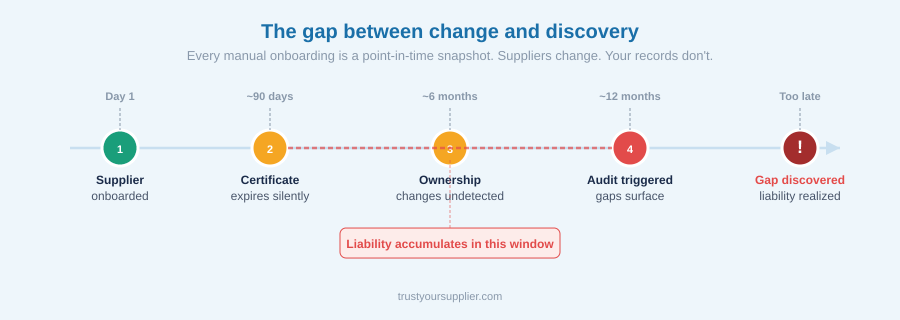
Onboarding captures a supplier's compliance status on one day. That information starts aging the moment it's recorded. Insurance certificates expire. Financial conditions change. Ownership transfers. Certifications lapse.
A supplier who was compliant at onboarding may not be compliant six months later. Without continuous monitoring, you won't know. The gap between when something changed and when you discovered it is where audit exposure and liability live.
4. Data that doesn't flow to the systems that need it
Manual onboarding creates data silos by default. Procurement approves the supplier. Finance sets them up in the ERP. Operations adds them to a vendor list. Each system has slightly different information. When anything changes, updates have to be made in multiple places manually, and they often aren't.
The result: no single source of truth, inconsistent data across systems, and manual reconciliation work that compounds every time a supplier changes a contact, address, or banking detail.
5. No audit trail behind the decisions you made
When an auditor asks why a supplier was approved, the answer shouldn't be in someone's inbox or memory. It should be in the system. Who reviewed what. What was verified. When it was verified. What was accepted as an exception and why.
Manual processes rarely produce this kind of record. When they don't, every audit becomes a reconstruction project. And exceptions that seemed reasonable at the time become indefensible on paper.
The Downstream Cost Is Bigger Than It Looks
The direct costs of manual onboarding are visible: staff time, delayed approvals, slow supplier activation. The downstream costs are less obvious and significantly larger.
-
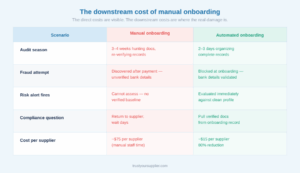
Click image to enlarge Audit preparation time. For teams with poor onboarding records, a compliance audit can take 3 to 4 weeks of document hunting, re-verification, and gap remediation. For teams with clean onboarding processes, it takes 2 to 3 days.
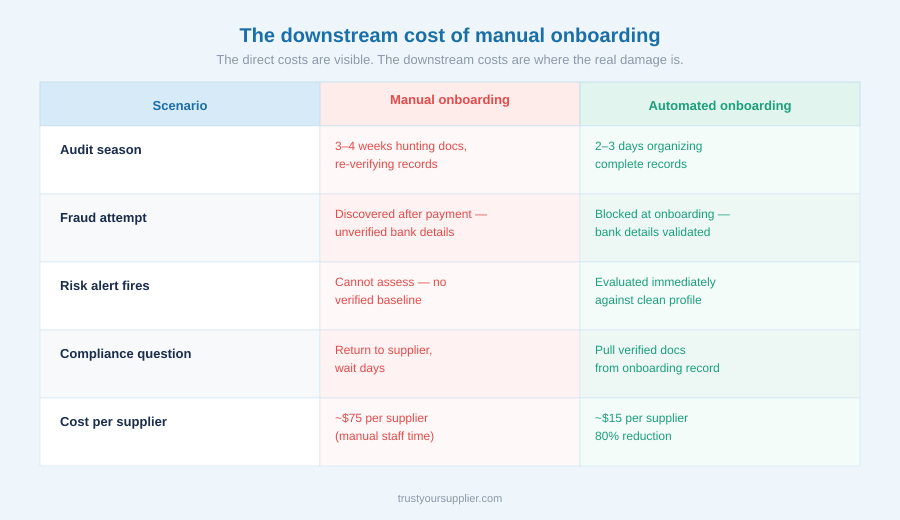
- Fraud exposure. Vendor payment fraud often enters through the onboarding process, specifically through unverified bank account details. 79% of organizations were targeted by payment fraud attacks in 2024. When bank details aren't verified at onboarding, they become a permanent vulnerability in the supplier record.
- Risk decisions built on bad data. If your risk scores and compliance assessments are running against unverified, incomplete, or outdated supplier data, the decisions you're making from those scores are only as good as the data behind them. Which means they may not be as good as you think.
- Remediation costs. Manual data cleanup is expensive and never fully complete. Deduplication, re-verification, document collection for gaps, ERP corrections. One industrial manufacturer discovered that 17% of their supplier records were duplicates, creating a significant remediation effort that could have been avoided with a structured onboarding process from the start.
What a Structured Onboarding Process Actually Changes
Fixing manual onboarding isn't about adding more steps to a checklist. It's about replacing the checklist with a process that catches errors at entry rather than discovering them downstream.
In practice, this means:
- Verification happens before approval, not after. Bank accounts confirmed through official channels. Tax IDs validated automatically. Business addresses checked against registries.
- Compliance requirements are enforced, not optional. Critical documents are required before approval, not collected eventually. Exceptions are documented with a reason and an approver.
- Data flows automatically to the systems that need it. Supplier information moves from onboarding into the ERP without manual re-entry, creating one source of truth rather than three slightly different versions.
- Ongoing monitoring runs automatically. Document expiry tracked. Alerts triggered before gaps appear. No one has to remember to check.
- Every decision is recorded. Who approved what, when, and why. Exceptions documented. An audit trail that exists without anyone having to build it.
The suppliers you onboard today will be in your systems for years. The data quality decisions made during onboarding define the quality of every interaction with that supplier going forward. Getting it right at entry is significantly cheaper than fixing it later.
The Evidence From Teams That Have Made the Shift
BT Sourced, the procurement arm of BT Group, was managing over 2,500 contracted suppliers through manual processes. After moving to automated onboarding workflows with pre-validated supplier data, they reduced supplier onboarding time by 55% and achieved an 85% supplier adoption rate.
The outcome wasn't just faster onboarding. It was cleaner data. Fewer verification gaps. A supplier record that could be trusted rather than questioned.
For mid-market teams, the shift is even more significant. When you're a small procurement team managing 500 to 2,000 suppliers without dedicated compliance staff, the manual approach isn't just inefficient. It's unsustainable. Automation doesn't replace the judgment of your team. It removes the low-value manual work that keeps your team from exercising that judgment on things that actually matter.
Where to Start
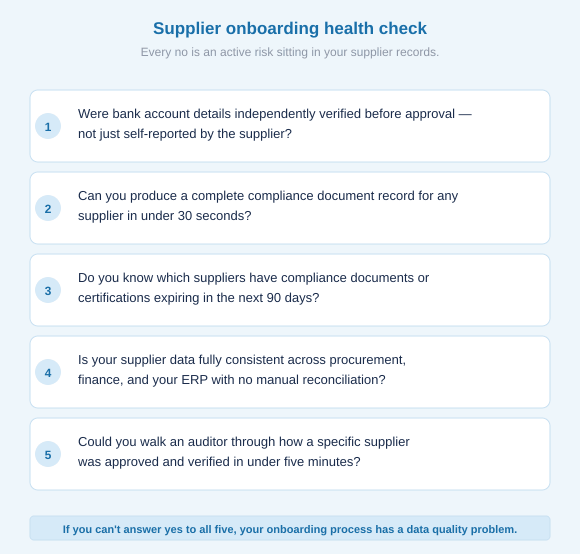
If your onboarding process relies heavily on email, spreadsheets, or shared drives, the first step is an honest audit of what your current process actually produces.
Ask these questions about a sample of recently onboarded suppliers:
- Were bank account details independently verified before the supplier was approved?
- Can you produce a complete compliance document record for each supplier in under 30 seconds?
- Do you know which suppliers have compliance documents expiring in the next 90 days?
- Is your supplier data consistent across procurement, finance, and your ERP?
- If an auditor asked you to walk them through how a specific supplier was approved, could you do it in five minutes?
If any of these questions surface uncertainty, the downstream risk is already present. The question is whether you discover it on your own terms or someone else's.
See What Structured Onboarding Looks Like in Practice
Trust Your Supplier helps mid-market procurement teams replace manual onboarding workflows with structured, automated processes that verify data at entry, enforce compliance requirements, and create clean supplier records from day one.
Take the 5-minute interactive onboarding tour to see how complete, verified supplier data flows from pre-qualification through activation into your systems.