
When Your Supplier Approval Process Gets Skipped: How to Handle Procurement Emergencies Without Creating Compliance Gaps

A project deadline is three days out. The preferred supplier can't deliver. Someone finds an alternative, calls in a favor, finds a vendor on a shortlist from two years ago, gets a recommendation from another department. The alternative can deliver on time.
There's just one problem: running them through your full supplier approval process will take three weeks.
So the approval gets skipped. The project ships. Everyone moves on.
Until the audit.
This scenario isn't rare. It's one of the most common ways compliance gaps enter supplier programs, not through negligence, but through urgency. Understanding how to handle procurement exception management properly is the difference between a defensible business decision and an undocumented liability.
Why Procurement Exceptions Happen (And Why They're Not the Problem)
Exceptions are a feature of real procurement, not a failure of it. Any approval process designed for normal operating conditions will encounter conditions that aren't normal. The goal isn't to eliminate exceptions. It's to govern them.
Procurement exception management is the process of documenting, authorizing, and remediating supplier approvals that bypass standard workflow due to time or business constraints.
An exception with documentation is a governance event. An exception without documentation is a liability.
The organizations that handle this well don't have fewer exceptions. They have better infrastructure for capturing them when they occur.
The Five-Minute Exception Documentation Framework
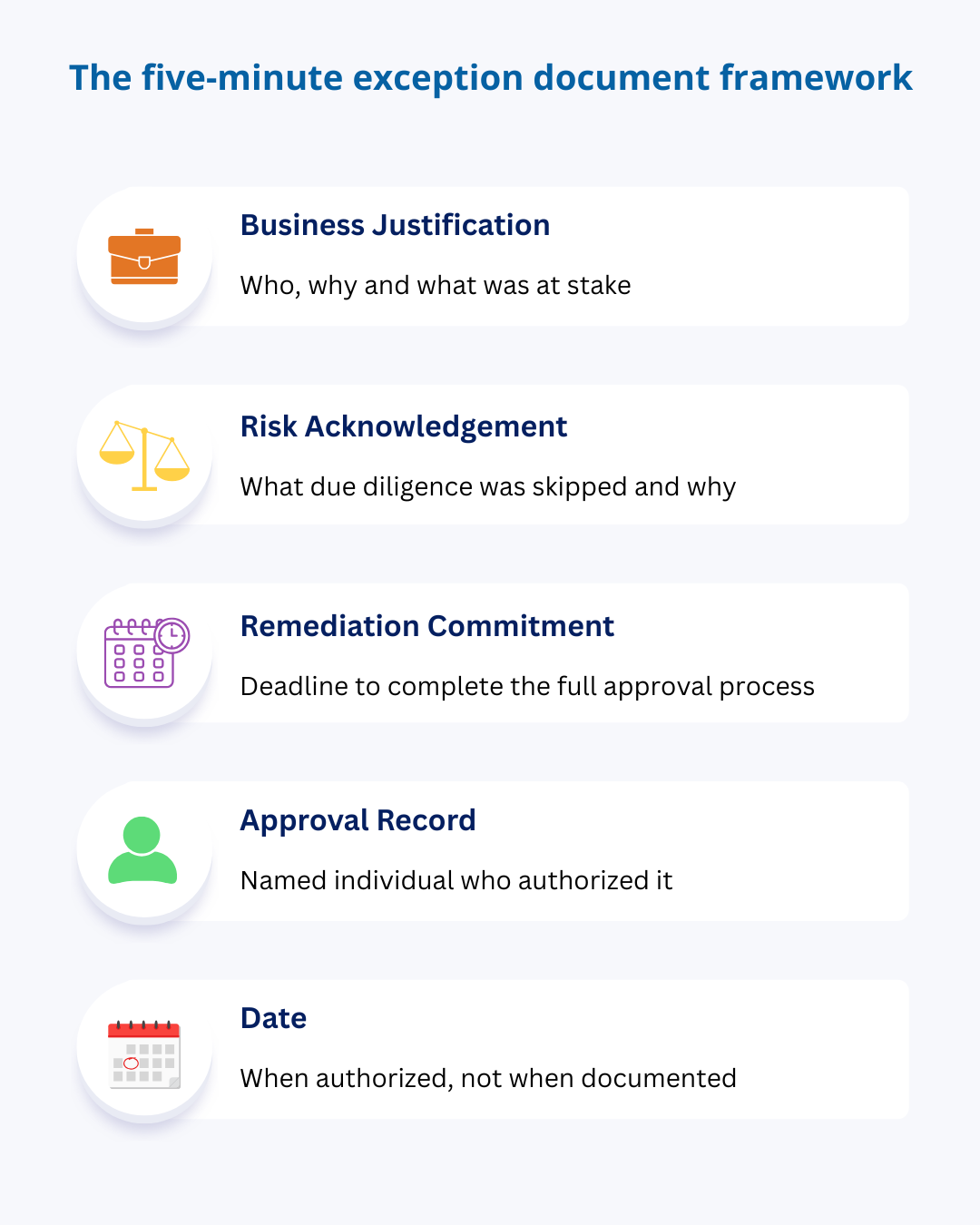
When urgency forces a supplier into your workflow before a full approval process can run, this is the minimum viable paper trail to create in the moment:
- The business justification (2 to 3 sentences): Who authorized this, why the standard process couldn't be followed, and what the business consequence of waiting would have been. This doesn't need to be formal. It needs to exist. Example: "Standard onboarding timeline is 15 business days. Project deadline was 72 hours. Delay would have resulted in [specific consequence: missed client delivery, production halt, etc.]. Approved by [name, role] on [date]."
- The risk acknowledgment: What due diligence wasn't completed and why. Even a one-line note, such as "Full compliance document review not completed prior to engagement; supplier flagged for retroactive review within 30 days," is materially better than silence.
- The remediation commitment: What you're committing to do after the emergency passes. A deadline for running the supplier through your standard supplier approval process. This transforms an exception into a controlled process gap rather than a permanent one.
- The approval record: Who signed off on the exception? At a minimum, the person who made the call. Ideally, their manager. The goal is a named individual, not an anonymous decision.
- The date the exception was authorized, not the date someone remembered to document it.
These five elements can be captured in a shared document, a ticket, an email thread marked for audit purposes, or a formal exception log. Whatever fits your existing infrastructure. The format matters less than the habit.
Building a Lightweight Exception Management Process
For teams that experience more than one or two exceptions per quarter, an informal documentation habit eventually breaks down. What replaces it is a simple exception log: a structured record that captures the five elements above for every out-of-process supplier engagement.
An effective exception log for procurement exception management tracks:
- Supplier name and engagement date
- Business unit and project
- Justification and authorizing approver
- Which standard steps were skipped
- Remediation deadline and completion status
This doesn't need to be sophisticated. A shared spreadsheet works. What matters is that it exists, that it's consistently used, and that it's accessible to whoever will need to explain these decisions later, whether that's an internal audit team, a compliance officer, or an external auditor.
The suppliers in that log who never get the retroactive review are your real risk exposure. The log makes that visible. Invisibility is the actual problem.
When Should You Escalate a Procurement Exception?
Not every exception is the same. Some are low-risk: a supplier you've worked with before who missed a renewal date. Some are higher-risk: a new vendor in a high-compliance spend category was brought in without any screening.
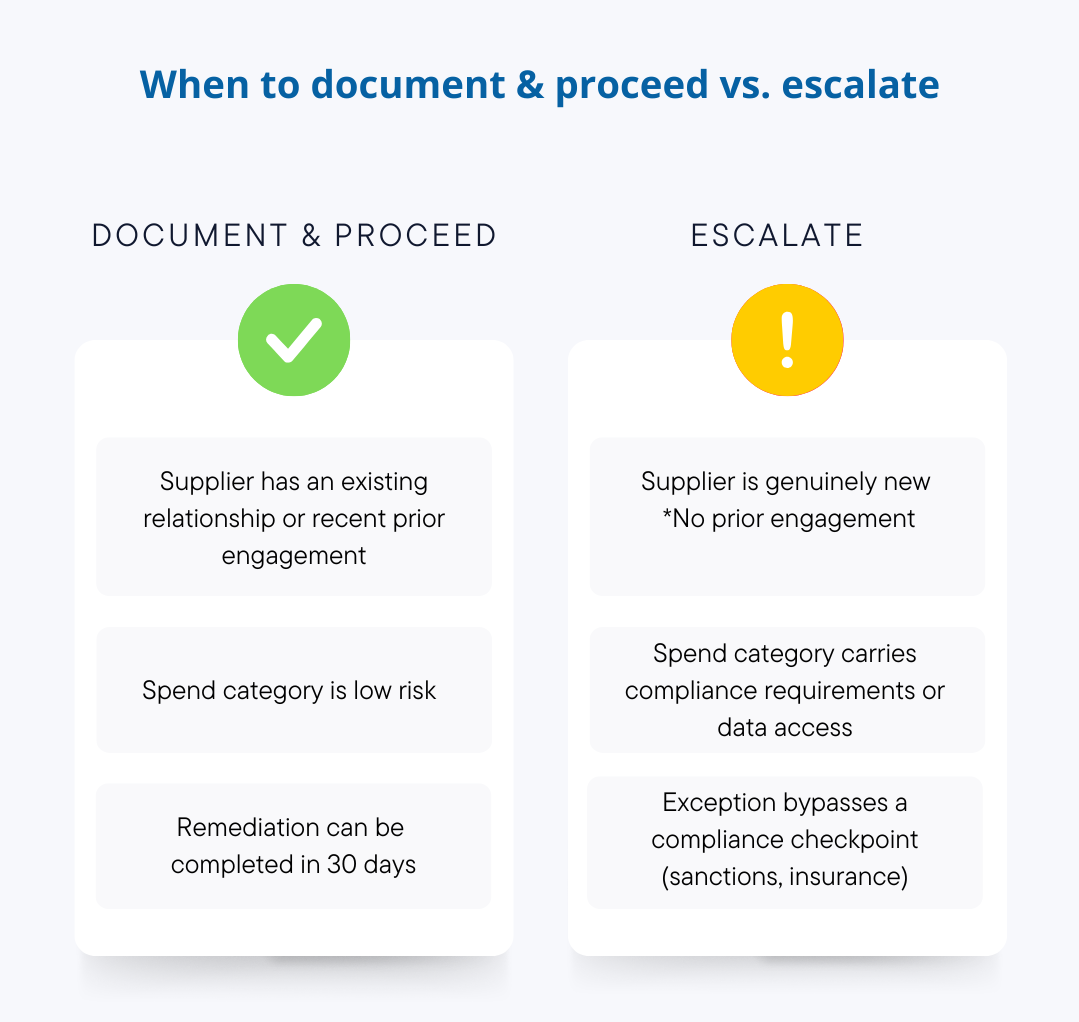
A rough decision framework:
Document and proceed when:
- The supplier has an existing relationship or recent prior engagement
- The spend category is low-risk (facilities, incidental services, low-value consumables)
- The time-bound need is clear and remediation can be completed within 30 days
Escalate before proceeding when:
- The supplier is genuinely new with no prior engagement history
- The spend category carries compliance requirements (financial services vendors, suppliers in regulated geographies, vendors with data access)
- The exception involves bypassing a compliance-specific checkpoint (sanctions screening, insurance verification, conflict of interest review)
The escalation doesn't need to be slow. A ten-minute call with a manager and a written follow-up achieves the goal. The point is that someone with appropriate authority was in the loop.
What TYS Policy Management Does Here
The documentation habit described above works. It also depends entirely on individual discipline, which means it degrades under pressure, varies across teams, and produces inconsistent records.
TYS Policy Management structures exception handling as part of the supplier workflow, not as an after-the-fact documentation exercise. When an approval process needs to be expedited or bypassed, the exception is captured inside the system: who authorized it, why, what was skipped, and what remediation is required. The audit trail is created at the time of the decision, not reconstructed later.
For procurement teams that handle exceptions regularly, and most mid-market teams do, moving from an informal log to a structured workflow is the step that makes exception management sustainable at scale.
The supplier approval process you have on paper is not the process your organization actually runs. The gap between them lives in the exceptions. Closing that gap doesn't require a perfect process. It requires a consistent habit of documenting the moments when urgency wins.
Start with the five-minute framework. Build the log. Then decide whether the volume and complexity of what you're managing warrants a more structured approach.
See how TYS Policy Management handles exception processing →