
What Your Supplier Data Is Costing You (And How to Find Out)

Most supplier data problems don't look like problems. They look like normal.
A record that hasn't been updated in two years. A bank detail that was entered manually at onboarding and never verified. A certification on file that expired six months ago. None of these trigger an alert. None of them show up in a dashboard. They just sit there, in the background, while decisions get made against them.
The cost isn't always visible until something goes wrong. A payment goes to the wrong account. An audit finds a lapsed compliance document. A contract renewal happens with a supplier whose ownership changed and nobody knew. By then, the cost isn't just financial. It's the time to investigate, the relationships to repair, the process to explain.
The question isn't whether your supplier data has gaps. It almost certainly does. The question is how much those gaps are costing you and where they are most likely to surface.
Where the Exposure Lives
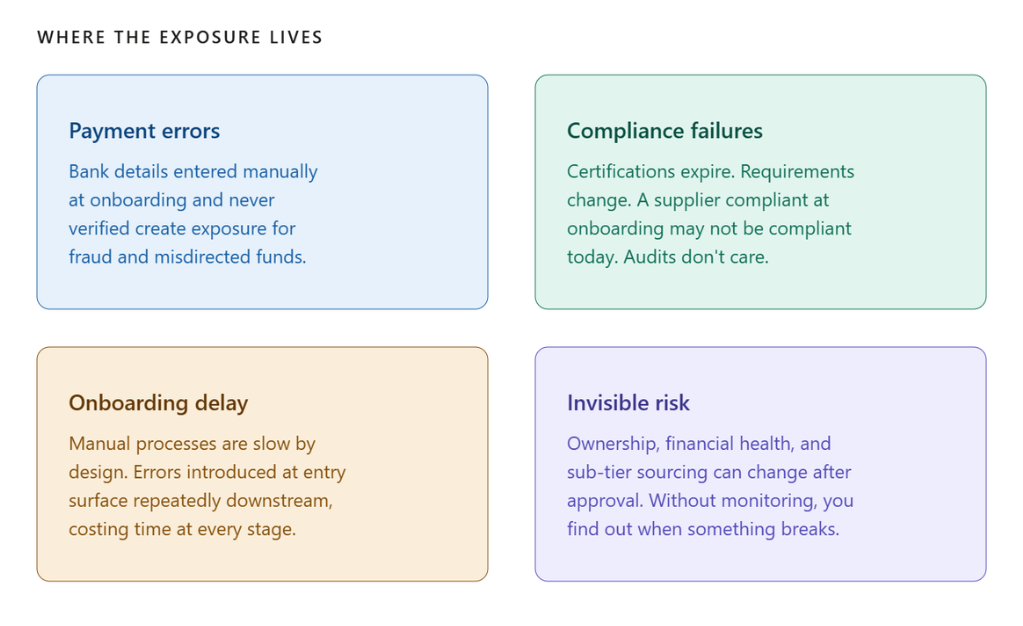
There are four places where inaccurate or incomplete supplier data turns into a real cost. Not theoretical risk. Actual cost.
Payment errors. When bank details are entered manually at onboarding and never independently verified, the information in your system is only as accurate as what the supplier submitted. That's a meaningful gap for any team sending regular payments. Payment fraud, misdirected funds, and duplicate payments all share the same origin: supplier records that were accepted rather than verified.
Compliance failures. Certifications expire. Regulatory requirements change. A supplier that was compliant at onboarding may not be compliant today. If your process relies on the supplier to notify you when something changes, you are managing compliance reactively. Audits don't care that you didn't know.
Onboarding delay. Manual onboarding processes are slow by design because humans are doing work that could be automated. The average manual onboarding cycle introduces data errors that have to be corrected downstream. Those corrections cost time at every stage they surface, and they surface more than once.
Invisible risk. A supplier's financial health, ownership structure, and sub-tier sourcing relationships can all change after you've approved them. If you're not monitoring those signals, the risk score you approved them on may not reflect where they stand today. You find out when something breaks, not before.
The Business Case Is Simpler Than It Looks
Building a case for better supplier data management is harder than a traditional savings business case. There's no line item that says "bad data" in the budget. The costs are distributed across AP, procurement, compliance, and legal. They don't appear together in the same report.
But they're real. Payment error recovery. Audit remediation. Compliance incident response. Supplier relationship repair. Add up the time your team has spent on any of these in the last 12 months and you have the beginning of a business case.
The organizations that handle this well don't wait for a failure to make the argument. They map the exposure first.
A Practical Starting Point
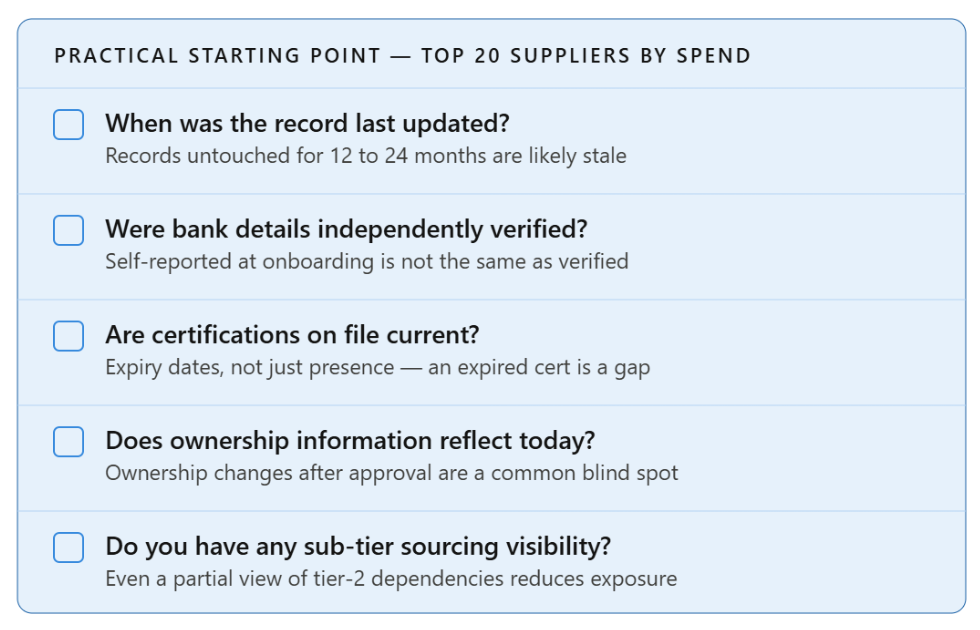
You don't need to audit every supplier record to understand your exposure. Start with the ones where the cost of getting it wrong is highest.
For each of your top 20 suppliers by spend, check five things: when the record was last updated, whether bank details were independently verified, whether certifications on file are current, whether ownership information reflects today's reality, and whether you have any visibility into sub-tier sourcing for that relationship.
If you can't answer those questions from your current system in under ten minutes, you already know where your exposure is.
The data that governs your supplier relationships should be at least as reliable as the relationships themselves. Most growing procurement teams know this. The ones who act on it before something breaks are the ones who don't spend a quarter cleaning up what they didn't catch.
The case for fixing this is easier to build than most teams expect.
See the Cost of the Status Quo →
The calculator gives you a practical estimate of what modern supplier onboarding could mean for your organization: faster cycle times, less manual effort, better compliance coverage. Based on your supplier volume and current process.
If you want the full framework for taking that number to leadership, the Building ROI and a Business Case for Digitizing Supplier Management whitepaper walks through how to structure the internal business case.
Frequently Asked Questions (FAQ)
What is supplier data risk? Supplier data risk refers to the financial, compliance, and operational exposure that results from inaccurate, incomplete, or outdated supplier records. Common examples include unverified bank details that enable payment fraud, expired certifications that create audit liability, and outdated ownership information that obscures third-party risk.
How do you calculate the cost of bad supplier data? The cost appears across several categories: payment errors and fraud recovery, audit remediation, compliance incident response, onboarding rework, and delayed supplier activations. Map these costs by function across the last 12 months, and you have a working estimate of your exposure.
How often should supplier records be updated? Best practice is a rolling refresh cycle for high-spend and high-risk suppliers at least annually, with automated monitoring for changes in ownership, certifications, and financial health. One-time onboarding verification without ongoing monitoring creates a gap that grows over time.