
When Your Airline App Is Smarter Than Your Supplier Management System

Why automation and integration are keys to effective risk management of your Supply Chain
Why automation and integration are keys to effective risk management of your Supply Chain
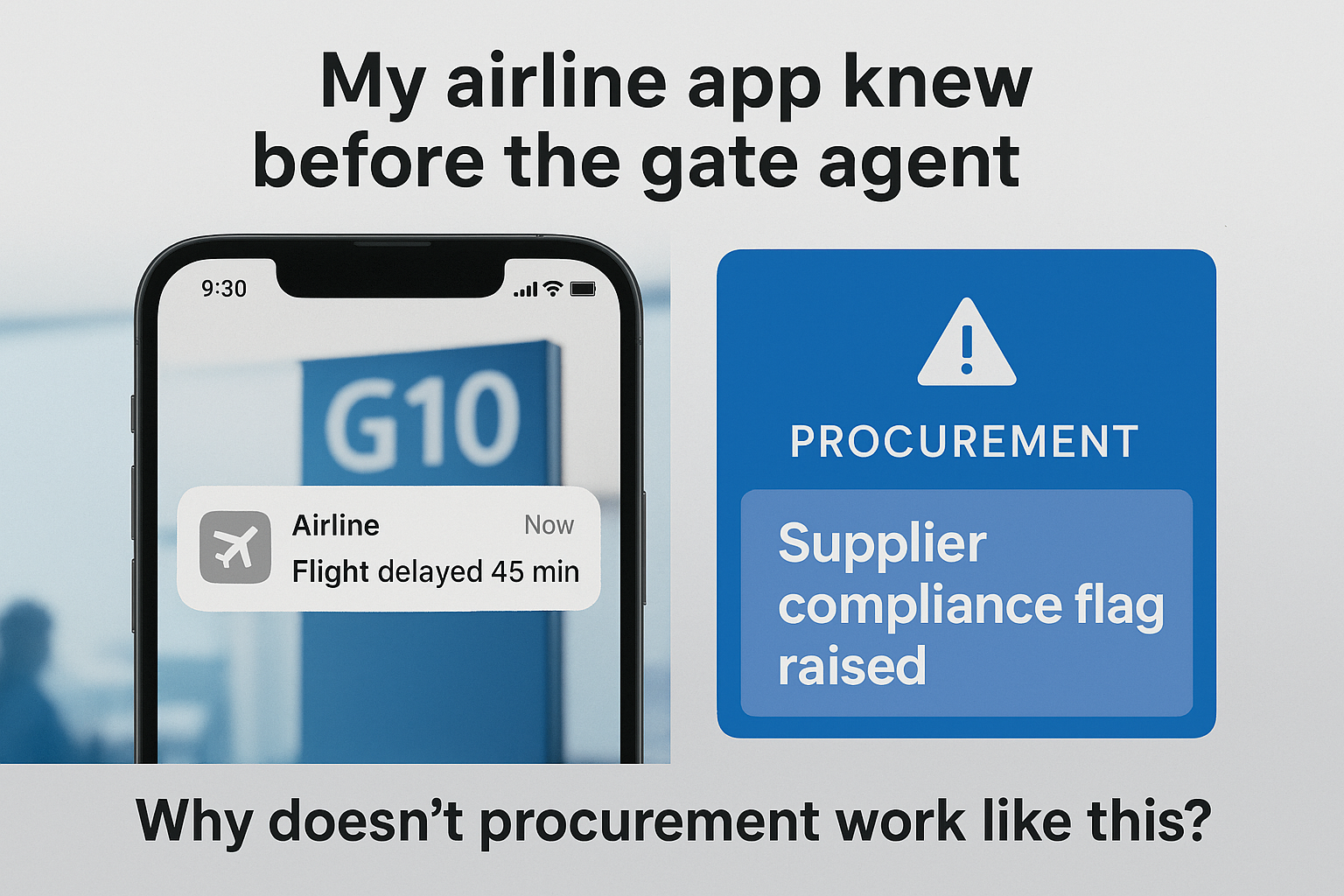
My airline app knew my flight was delayed before the gate agent did.
I sat at the gate last week, waiting to board. My phone buzzed: "Flight delayed 45 minutes."
I looked up. The departure board still showed on-time. The gate agent was still boarding the previous flight, completely unaware of what was coming.
My phone knew before the people running the operation.
That moment stuck with me—not because I was annoyed about the delay, but because of what it revealed about how information moves in well-integrated systems versus fragmented ones.
And I thought about procurement.
Who Knows First?
I keep coming back to one question. When something changes with a critical supplier, who finds out first in your organization?
- When a supplier's certification is about to expire, does someone get an alert? Does it sit buried in a spreadsheet until the next quarterly review?
- When a compliance flag gets raised, does it hit your phone? Or does it languish in someone's inbox while the clock ticks?
- When a key supplier changes ownership, gets acquired, or fails an audit, do you know immediately? Do you find out weeks later when something breaks in production?
Most procurement teams fly blind. Not because they're not good at their jobs. Not because the data doesn't exist.
But because the data is trapped in systems that don't talk to each other.
The Data Exists. It's Just Not Connected. And that's a Risk!
Your ERP knows transaction history—spend patterns, order frequency, payment terms.
Your compliance platform knows audit status, certifications, and risk scores.
Your email has the supplier's updated insurance certificate.
Your contract management system has renewal dates and SLAs.
But none of them are talking to each other.
This leaves your team manually stitching together the full picture. Pulling reports from five different systems. Hoping nothing falls through the cracks.
And when something does fall through; a lapsed certification, a missed audit, a supplier that should have been flagged months ago, the cost isn't just operational. It's reputational. It's regulatory. Sometimes it's catastrophic.
The Airlines Figured This Out Years Ago
The airlines solved this problem through integration. They connected their systems so that passengers—passengers—get better information than their own gate agents.
Flight status flows from air traffic control to operations to the app in your pocket in near real-time. You're notified of delays, gate changes, and cancellations the moment the system knows.
It's not magic. It's just integration done right.
And if airlines can do it for millions of passengers across thousands of flights every day, procurement teams can do it for their supplier base.
What Real-Time Supplier Intelligence Looks Like
Imagine this instead:
- A push notification routes to your compliance manager the moment a supplier's ISO certification is 60 days from expiration—with the supplier automatically notified and a workflow triggered to collect the renewal.
- A dashboard flag sets for your procurement lead when a Tier 1 supplier's financial health score drops below threshold, weeks before it impacts delivery.
- A team alert generates when a supplier fails an audit or changes ownership, with all relevant contracts and risk assessments surfaced in one view.
You don't have to imagine it. The technology exists. The data exists.
What's missing is the connective tissue—the integration layer that turns isolated data into actionable intelligence.
The Cost of Waiting
I see companies every day that are still managing supplier risk the way I used to check flight status—by walking up to the gate and hoping for the best.
It's reactive. It's inefficient. And in today's regulatory environment, it's increasingly risky.
The organizations that win in procurement aren't the ones with the most data. They're the ones who've connected their data in ways that let them act faster, smarter, and with more confidence than their competitors.
So, here's my question for you:
What critical supplier information do you wish you knew in real-time?
What's the supplier risk equivalent of "your flight is delayed"—the thing you'd want to know immediately, before it becomes a problem?
Because the gap between what you could know and what you actually know might be the biggest risk sitting in your supply chain right now.
🔍 If real-time is your goal, TYS Essentials can help you get there.
Sai Nidamarty is the CEO and Co-founder of Trust Your Supplier (TYS), an advanced procurement technology platform that brings real-time intelligence to supplier management. He built TYS to solve the risk management challenges that procurement operations.