
How to Write a Risk Finding That Gets Funded

Your risk register probably already lists the gap you're most worried about. It has a likelihood rating, an impact rating, and a review date. None of that has been enough to fund it.
That's not a formatting problem. A register is built to compare gaps against each other at a glance, so it strips out exactly the detail that would make any one of them stand out: who's actually affected, what the actual mechanism is, and what somebody would have to say out loud if it went wrong. Fix that, and the same gap reads completely differently, without a single new fact.
Here's how to rewrite one entry, and why it beats almost anything else you can do with an afternoon and no new data.
Turn the Category Into a Sentence
Pick one gap from your register. Not the whole list, just one, ideally the one you'd defend hardest if someone asked why it's still open.
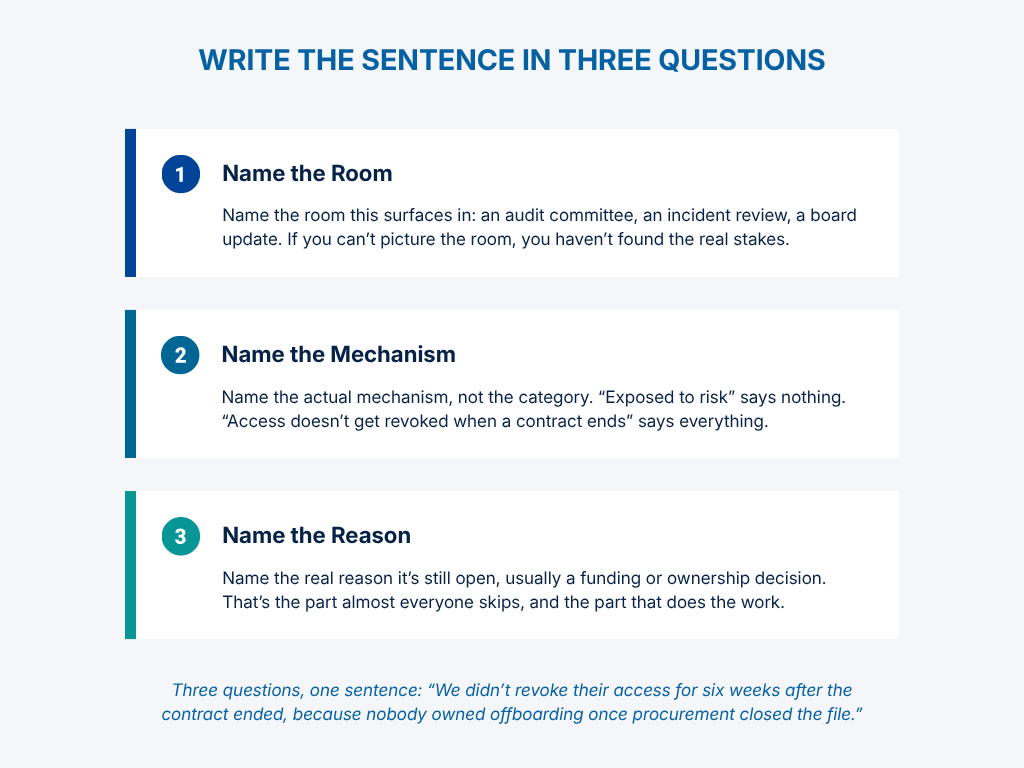
Answer three questions about it, in order:
Who would actually have to explain this, and where? Not a category of person. A specific forum: the audit committee, a post-incident review, a board risk update. If you can't picture the room, you haven't found the real stakes yet. That room got a lot more concrete this year: the IIA's new Third-Party Topical Requirement gives internal audit an actual checklist to test your program against. See what the standard actually requires →
What's the actual mechanism, not the risk category? "Exposed to fraud risk" is a category. "Nobody checks whether a bank-detail change came from the real vendor" is a mechanism. The mechanism is what you're missing on the register right now.
What's the real reason it's still open? Usually it's a funding decision, sometimes an ownership decision. Either way, name it. This is the part almost everyone leaves out, and it's the part that does the work.
Put the three answers together as a sentence that person would actually say, in that room, if it came to that.
Worked example. Take a vendor-offboarding gap: access doesn't get revoked automatically when a contract ends, someone has to remember to do it. On the register, that's "Vendor offboarding, medium likelihood, reviewed quarterly." As a sentence: "We didn't revoke their system access for six weeks after the contract ended, because nobody owned offboarding once procurement closed the file."
Same gap. Completely different reaction once it's read out loud.
Aim the Sentence at the Decision, Not the Person
The sentence only works if it ends on a decision, not a person. "We didn't revoke access because Dana forgot" invites blame and gets forgotten along with everything else about Dana. "We didn't revoke access because nobody owned offboarding once procurement closed the file" points at the actual structural gap, which is the thing a budget conversation can actually fix.
This matters more than it sounds. A sentence that reads as finger-pointing gets defended against instead of acted on, and you lose the exact reaction you were trying to produce.