The AI You Never Approved Is Already Scoring Your Suppliers

The AI You Never Approved is Already Scoring Your Suppliers

You can govern the AI your team decided to use. You cannot govern the AI you didn't know was there. 

That distinction came up directly at a recent TYS webinar on AI governance in procurement, when an attendee asked a question most governance frameworks aren't built to answer: what about the AI already embedded in the tools you rely on? Not the ones you deployed, but the ones your data providers built? An ESG score. A financial risk score. A number that shows up in your supplier record and gets treated as fact. 

Gary Storr, Chief Sales and Marketing Officer at Trust Your Supplier, didn't soften the answer. 

"Part of the process is determining where AI solutions are being implemented, and that's becoming increasingly difficult to identify as technology absorbs AI into its very fabric," Gary said. "You have to make the assumption that practically any data point you're receiving today has been processed by some kind of AI. It's your job to talk to your vendors and data providers and ask the simple question: how much of this has been augmented by AI, and how is it being done? Learn what that process looks like, so you can evaluate how you have to govern it, how you have to audit it, and what you need to do to ensure the information you're receiving is something you can verify and trust."

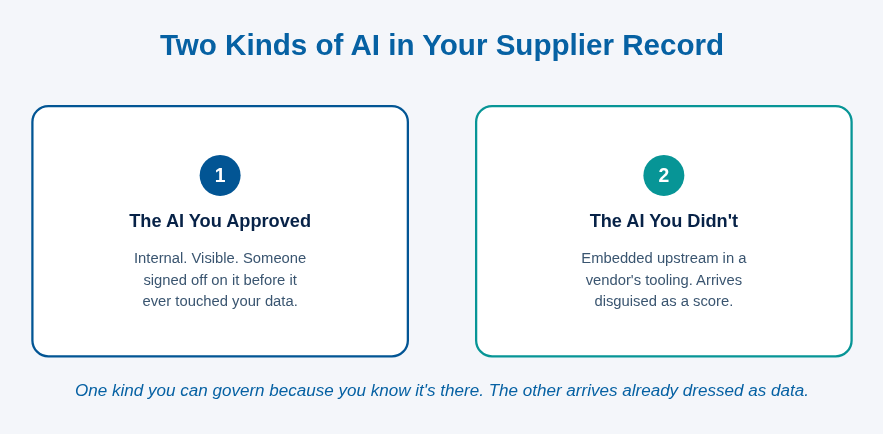
Two panels on a light blue-gray background titled "Two Kinds of AI in Your Supplier Record." Panel one, blue accent, "The AI You Approved": internal, visible, someone signed off on it before it ever touched your data. Panel two, teal accent, "The AI You Didn't": embedded upstream in a vendor's tooling, arrives disguised as a score. Caption below: one kind you can govern because you know it's there, the other arrives already dressed as data.
Click image to enlarge.

The Governance Model Most Teams Have Built 

Most AI governance conversations in procurement start and end with the same question: what are we using AI for, and who approved it? That's a reasonable starting point. It's also incomplete. 

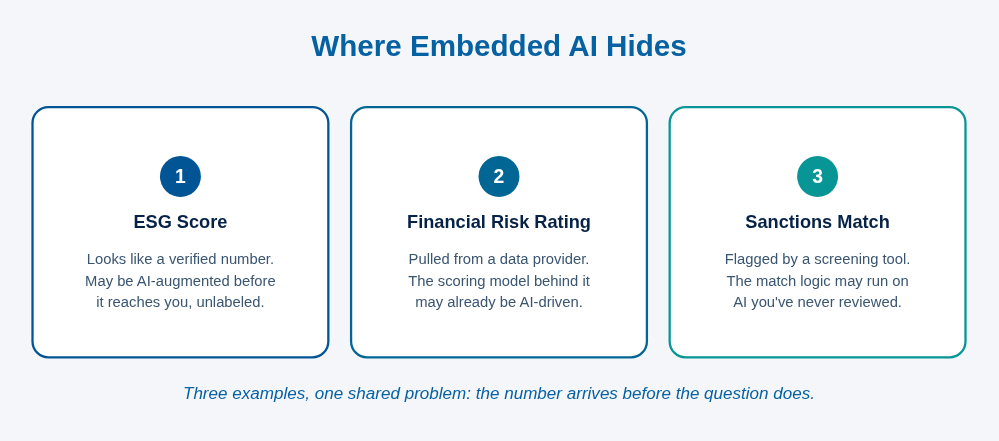
A governance model built only around internal AI use assumes the AI touching your supplier data is AI your organization chose. In practice, a growing share of it isn't: the ESG score in your supplier profile, the financial risk rating pulled from a data provider, the sanctions match flagged by a screening tool, any of these can be AI-generated or AI-augmented upstream, before the number ever reaches your system. 

You never see that process happen. You just see the output: a score, a flag, a rating that looks exactly as authoritative as data your team verified directly. Nothing distinguishes the two once they land in the same record. 

Three panels on a light blue-gray background titled "Where Embedded AI Hides." Panel one, blue accent, "ESG Score": looks like a verified number, may be AI-augmented before it reaches you, unlabeled. Panel two, teal-blue accent, "Financial Risk Rating": pulled from a data provider, the scoring model behind it may already be AI-driven. Panel three, teal accent, "Sanctions Match": flagged by a screening tool, the match logic itself may run on AI you've never reviewed. Caption below: three examples, one shared problem, the number arrives before the question does.
Click image to enlarge

Why This Blind Spot Is Easy to Miss 

It rarely gets flagged as a governance gap. Teams that have done real work on AI governance internally often assume the job is done, because the visible AI, the chatbot, the copilot, the internal tool, is accounted for. The invisible AI is a different problem entirely: it doesn't announce itself, it doesn't require sign-off, and it arrives already dressed as data. 

This isn't a hypothetical. As Gary put it, assume any data point you receive today has been processed by some kind of AI in some way. That assumption changes how you should treat a number you didn't generate yourself.

We cover topics like this every week. Practical supplier management insights for procurement and supply chain teams. Get it in your inbox →

What Asking the Question Actually Looks Like 

Gary's answer isn't a call to stop using third-party data providers, so much as a call to ask them one specific question before treating their output as ground truth: how much of what you're sending me has been augmented by AI, and how? 

That question does real work: it tells you which numbers in your supplier record need more scrutiny before a decision leans on them, gives you something to point to if a regulator or auditor asks how a score was produced, and puts the provider on notice that their AI use is now part of your governance conversation, not outside it. 

None of this requires new tooling, only a willingness to ask a vendor a question most procurement teams have never thought to ask. 

Where TYS Fits 

Trust Your Supplier's own AI runs inside a governed, auditable environment by design, not as a governance layer bolted on after the fact. TYS Agents operate on your verified supplier data within a governed, auditable environment. No supplier data passes through consumer AI tools. Every agent action is logged, timestamped, and traceable, the same auditability your compliance team requires from every other part of your procurement process. 

That's the standard Gary is describing for every AI touchpoint in your supplier data, including the ones that live outside TYS. Asking your data providers the same question you'd ask any system touching supplier data isn't an extra step. It's the same governance discipline, applied consistently. 

Explore how agentic AI is changing supplier risk management → 


AI in Procurement Blog
Previous reading
The AI You Never Approved Is Already Scoring Your Suppliers
Next reading
Accidental Governance: Why Your Supplier Compliance Program Only Works on Paper