
Accidental Governance: Why Your Supplier Compliance Program Only Works on Paper

Most supplier compliance programs have a documented process. A workflow. An approval structure. Someone wrote it down.
What many organizations discover, usually during an audit or after a payment goes wrong, is that the written process and the actual process differ. Not because anyone was negligent. Because ownership was never clearly assigned, and the gap filled itself in.
That gap has a name. Gary Storr, VP of Business Development at Trust Your Supplier, calls it accidental governance.
"Ownership is extremely important in any governance process," Gary explains. "My experience is that either everybody wants to own the process, which means no one does, or no one wants to own it because it's a time bomb. And so we have these gaps in ownership. When a governance step has to be executed reactively, somebody creates a spreadsheet, or today maybe somebody jumps into ChatGPT and makes something up. This is just a floating governance model that has no direction."
The VCR analogy Gary uses is hard to forget: if you just plug in a tool and turn it on without telling it how to operate, your governance process is blinking 12:00 all the time. You never know what time it is.
What Accidental Governance Looks Like
It rarely announces itself. It builds quietly, in the space between what the policy says and what actually happens under pressure.
A new supplier needs to be onboarded in three days because a project deadline is immovable. The standard qualification process takes two weeks. Someone handles it, creates a quick checklist, gets verbal approvals, documents what they can, moves on. The supplier goes live. The project ships.
Nobody intends to circumvent the process. They intend to get the work done.
But three months later, that supplier is active in the system without a completed compliance questionnaire, unverified bank details, and no record of who approved the exception or why.
That is accidental governance. And it compounds. Each time a step gets handled ad hoc, the informal workaround becomes a little more normal. Eventually, the informal process is the real process, and the documented one is the thing nobody actually follows.
Why It Happens
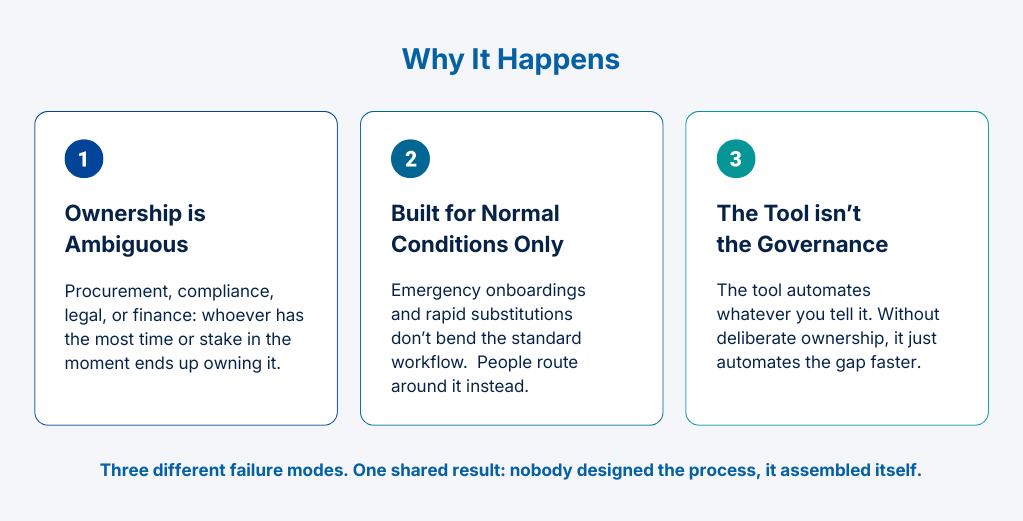
Accidental governance is a structural problem, not a people problem. It shows up most reliably in three situations.
Ownership is ambiguous. When a governance step has multiple possible owners (procurement, compliance, legal, finance), it often ends up owned by whoever has the most time or the most at stake in the moment. That changes person to person and situation to situation. Consistency disappears.
The process was designed for normal conditions. Most governance workflows were built for standard operating situations. When conditions are not standard (an emergency onboarding, a disruption requiring rapid supplier substitution, a new regulation that arrived faster than the process could adapt), the workflow does not bend gracefully. People work around it.
The tool is expected to provide the governance. Many organizations assume that deploying a supplier management platform will create governance. It will not. As Gary puts it, the tool does exactly what you tell it to do. If you have not made deliberate decisions about ownership, workflows, and escalation paths, the tool will faithfully automate your accidental governance rather than replace it.
What It Costs
The cost of accidental governance is mostly invisible until it is not.
Audit exposure accumulates in every undocumented exception. A supplier approved without a completed questionnaire, a certification that expired without a monitored renewal workflow, an approval that exists in someone's email but not in the system of record: each one is a gap that an auditor will find before you do.
Institutional knowledge walks out the door. When decisions live in people's heads rather than in documented systems, every departure takes the governance context with it. The person who knew why a supplier was approved despite a borderline risk score is no longer there to explain it when the question gets asked two years later.
Decision quality degrades quietly. When the governance process is inconsistent, so are the decisions it produces. Two similar suppliers evaluated six months apart by different people following different informal processes will produce different outcomes, not because the risk is different, but because the process was never stable.
What Deliberate Governance Requires
The fix is not more documentation. Organizations that respond to governance gaps by writing longer policies tend to create more impressive binders that fewer people read.
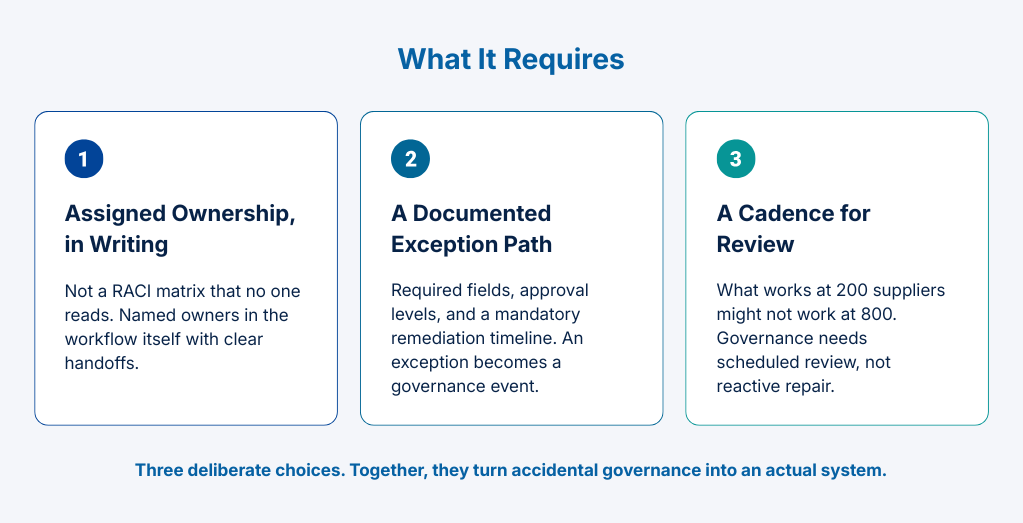
Deliberate governance requires three things.
Assigned ownership, in writing. Not a RACI matrix nobody references. Actual named owners in the workflow itself, with clear handoffs. When a governance step fires, one person knows it is their job.
A process that accounts for exceptions. Emergency onboardings and off-cycle approvals will happen. Building a documented exception path with required fields, approval levels, and a mandatory remediation timeline turns an exception into a governance event rather than a liability.
A cadence for reviewing and updating the model. The governance process that works at 200 suppliers may not work at 800. The regulatory environment that existed when the program was designed may have changed. Governance programs need scheduled review, not just reactive repair.
As Gary notes, it is like planting a tree. The preparation and planting matter. But you have to nurture it. Otherwise it dies. That is what happens to so many governance processes that organizations put in place. The go-live is where the project ends. Governance is where it starts.
The Supplier Data Layer Underneath It All
Accidental governance creates a specific data problem that compounds over time. Every undocumented decision, every ad hoc approval, every informal workaround leaves a supplier record that looks complete on the surface but carries hidden gaps underneath.
When those records become the foundation for AI-assisted decisions (risk scores, compliance flags, sourcing recommendations), the quality of the output depends entirely on the quality of the data underneath it. A governance model that has been running informally for years produces supplier records that were accurate on the day they were created and have been drifting ever since.
Building deliberate governance is not just a compliance exercise. It is the infrastructure that makes every downstream decision more reliable.
Where TYS Fits
Trust Your Supplier gives procurement teams the structure accidental governance is missing: assigned ownership, documented exception paths, and an audit trail that holds up when someone finally goes looking for it.
✅ Deliberate, assigned governance ownership instead of ambiguous handoffs
✅ A documented path for exceptions, with approval levels and remediation timelines built in
✅ Supplier records built to support reliable AI-assisted decisions, not just pass an audit
See what that looks like in practice: Take the TYS Essentials Onboarding Tour →