
Your Supplier Data Has an Expiry Date. Most Teams Miss It.


The approval is done. The vendor is active. There is a record in the system with a date on it, and that date feels like evidence of something solid.
It is not. It is a timestamp on a snapshot.
The supplier you onboarded twelve months ago may have changed ownership since then. Their insurance certificate may have lapsed. The certification they submitted has an expiry date that nobody tracked. Their financial risk profile shifted after a credit event that happened six months after you approved them. None of that shows up in the original record because none of it existed when the record was created.
This is the data drift problem. It is cumulative, and it is sitting inside most supplier bases right now. The onboarding process created a foundation. Time has been eroding it.
Why Supplier Data Ages Faster Than Most Teams Realize
A supplier record that was accurate and complete at onboarding becomes progressively less reliable as the relationship matures. Here is what changes, usually without anyone noticing:
- Ownership and corporate structure. Companies are acquired, restructure, or transfer beneficial ownership. The entity you contracted with may no longer be the entity processing your invoices.
- Bank and payment details. Suppliers update payment information for legitimate reasons. Fraudsters also submit change-of-bank-details requests designed to look like routine updates. Either way, details verified at onboarding and never rechecked are a vulnerability.
- Compliance certifications and insurance. Every document has an expiry date. Most onboarding workflows collect these once and file them. The expiry passes. Nobody notices until an audit or an incident makes it impossible to ignore.
- Financial and risk profile. Credit conditions deteriorate, sanctions exposure shifts, ESG posture changes. A supplier that scored low risk at onboarding may be a materially different risk today.
- Regulatory requirements. What counted as adequate due diligence two years ago may not meet the standard your auditors are applying now. Frameworks evolve. Records do not update themselves.
The record in your system does not change when any of these things happen. It just ages.
How to Prioritize Your Revalidation Exercise
Not every supplier in your base carries the same urgency. A revalidation exercise applied uniformly across every vendor relationship is not a realistic starting point for most mid-market teams. Prioritization by risk and spend is the practical approach.
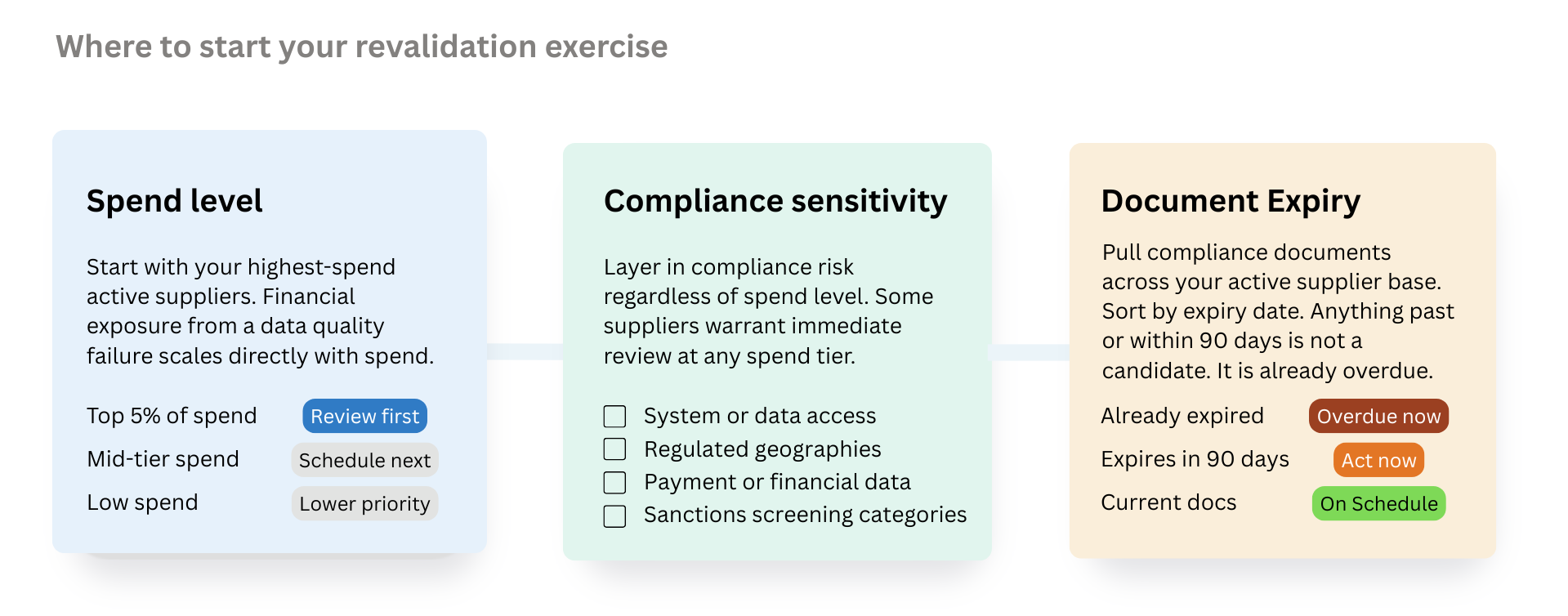
Start with your highest-spend suppliers. The financial exposure attached to a data quality failure scales directly with spend. A supplier representing five percent of your total spend deserves more scrutiny than one representing half a percent, regardless of category.
Layer in compliance sensitivity. Suppliers with access to your systems or data, suppliers operating in regulated geographies, suppliers in categories subject to specific legal or audit requirements, and suppliers who hold financial data or payment credentials sit at the top of any revalidation priority list regardless of spend level.
Add document expiry date as a third filter. Pull the compliance documents on file across your active supplier base and identify which ones have expiry dates in the past or within the next ninety days. These are not revalidation candidates. They are already overdue.
The combination of high spend, compliance sensitivity, and lapsed or near-expiry documentation gives you a working priority list. That list is where a targeted revalidation effort starts.
What a Structured Revalidation Process Covers
Revalidating a supplier is not the same as onboarding them again. The relationship exists. The history is there. The goal is to update and verify the data that has aged, not to restart from scratch.
A structured revalidation exercise covers five areas:
Compliance documentation. Collect current versions of all documents with expiry dates. Verify that they are current, that they come from a credible source, and that the issuing authority confirms validity where possible. A supplier-submitted document alone is not sufficient verification.
Ownership and corporate structure. Confirm that the legal entity, beneficial ownership, and corporate structure on file match current reality. This is particularly important for suppliers in markets with higher rates of ownership transfer, and for any supplier where a change in control could trigger sanctions or conflict-of-interest concerns.
Bank and payment details. Reconfirm the bank details on file through an independent verification step, not just a supplier-submitted update. Payment fraud through bank detail change requests is one of the most common fraud vectors in procurement.
Risk profile. Run the supplier through your current risk screening criteria, including any third-party data sources you use for financial health, sanctions, ESG, and cyber risk. Compare the result against the original onboarding assessment and document any material changes.
Regulatory compliance. Confirm that the supplier still meets the compliance requirements applicable to the relationship under current regulatory frameworks, including any requirements that have come into effect since onboarding.
The Difference Between Monitoring and Revalidation
These two practices are related but distinct, and both matter.
Continuous monitoring watches for changes in real time. It flags when a sanctions status changes, when a financial risk signal crosses a threshold, or when a document expiry date is approaching. It tells you when something has changed and requires your attention.
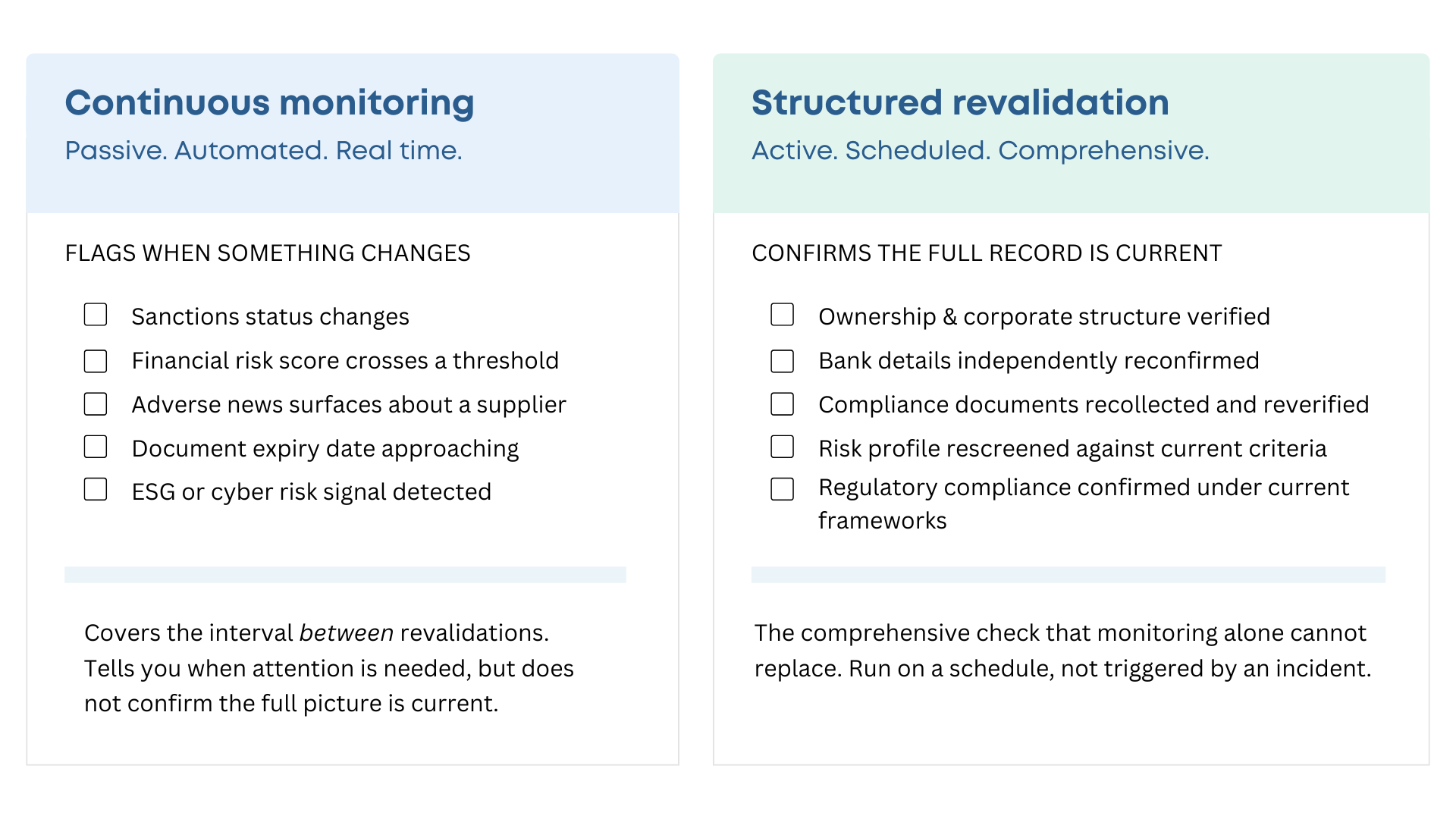
Revalidation is active and periodic. It is the deliberate decision to take a supplier through a structured review process to confirm that the full picture is current and accurate.
Think of it as the difference between a smoke detector and a fire inspection. The smoke detector catches what changes in real time. The inspection confirms that the whole system is still sound.
Both serve a purpose. Monitoring covers the interval between revalidations. Revalidation provides the comprehensive check that monitoring alone cannot replace.