AI-Ready Supplier Data: Five Questions to Ask Before You Deploy

Before deploying any AI tool in supplier risk management, audit your supplier data against five criteria: verification status, field structure, change capture processes, field completion rates, and offboarding documentation. This post walks through each one with the specific question to ask your team.
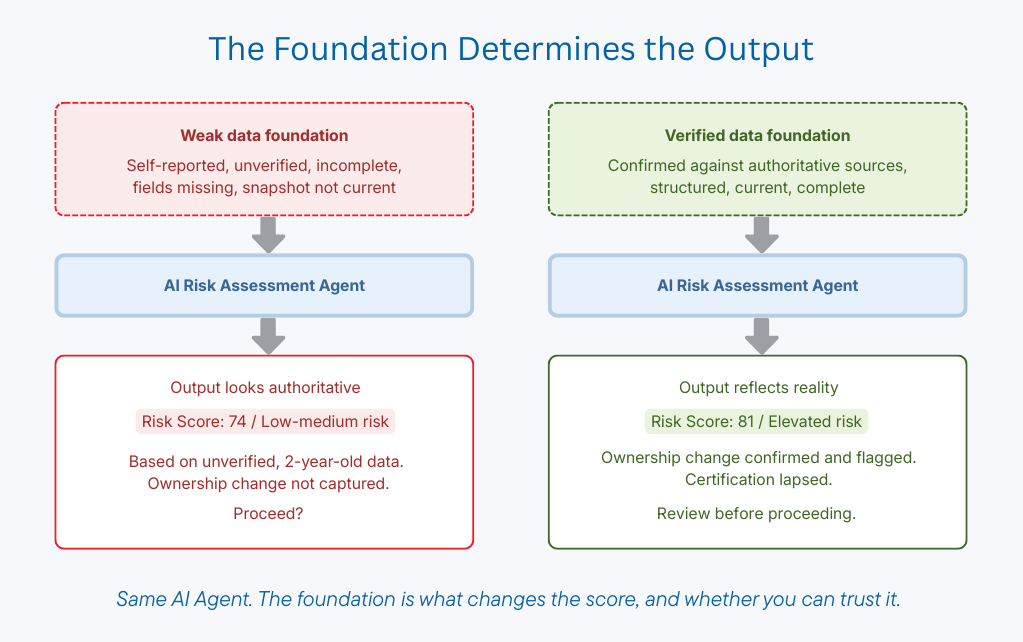
Every AI tool your procurement team is considering right now comes with a version of the same promise: better visibility, faster decisions, smarter risk flags. Some of those tools will deliver on that promise. Some won't. But the variable that determines which outcome you get usually has nothing to do with the tool itself.
It has to do with the supplier data the tool runs on.
Before your team evaluates a single AI product, it's worth asking five questions about the data that product will be reading. The answers will tell you more about your AI readiness than any vendor demo will.
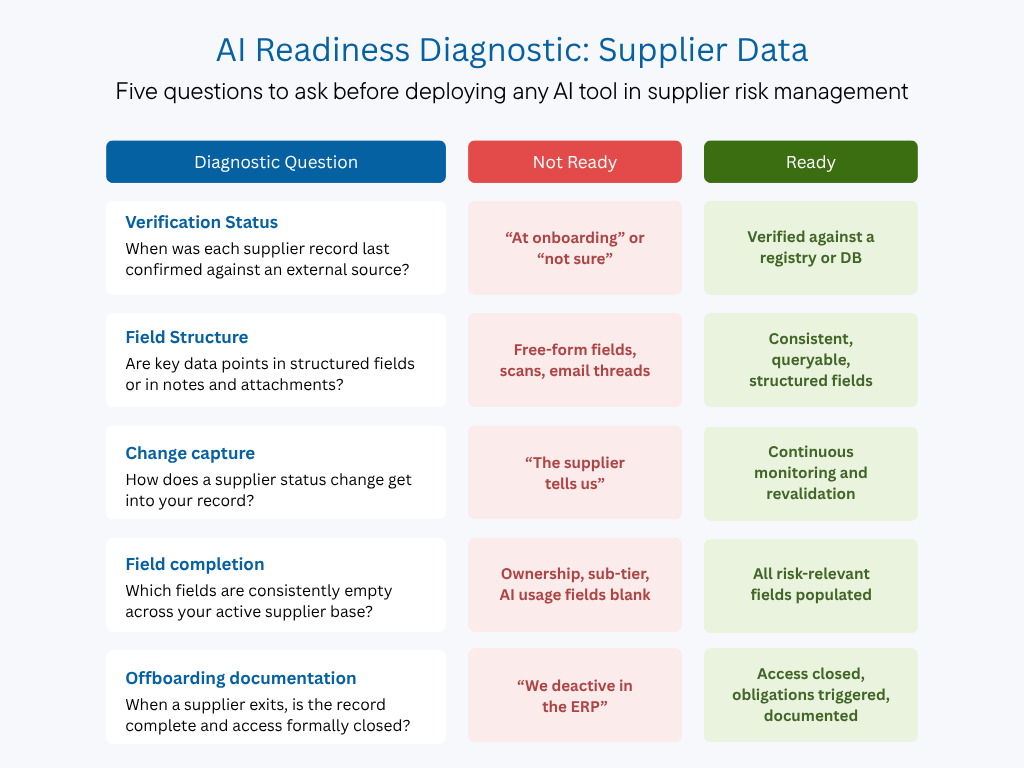
Question 1: When was this supplier record last verified?
Verification status: when supplier records were last confirmed against an authoritative source.
Not updated. Verified.
There's a difference. Updating a record means someone changed a field. Verifying a record means the information in that field was checked against an authoritative source: a business registry, a sanctions list, a certification database, or a bank verification service.
Most supplier records in most systems were populated at onboarding by the supplier themselves, accepted as submitted, and never independently confirmed. If that describes your records, your AI tool will be running assessments on self-reported data that may be months or years out of date.
The question to ask your team: for your top 20 highest-spend or highest-risk suppliers, when was each record last verified against an external source? If the answer is "at onboarding" or "I'm not sure," that's where to start.
Question 2: Are your supplier fields structured or free-form?
Field structure: whether supplier data is captured in consistent, machine-readable fields or scattered across notes and attachments.
AI tools need structured data. They need to read a field called "Country of Incorporation" that contains a country name, not a notes field that says "registered in DE I think, check with legal."
Free-form text fields, scanned document attachments, and information buried in email threads are not queryable. An AI agent cannot reliably extract, compare, or act on data that isn't in a consistent, machine-readable format.
Pull up five random supplier records in your system right now. Count how many fields are free-form versus structured. Count how many important pieces of information live in a notes field or an attachment rather than a dedicated field. That ratio is a direct indicator of how much of your supplier data an AI tool can actually use.
Question 3: How does your team find out when something changes?
Change capture: whether updates to supplier status, certifications, or ownership reach your records before they create a problem.
A supplier changes ownership. A certification lapses. A financial rating drops. A key contact leaves.
How does that change get into your supplier record?
If the answer is "the supplier tells us" or "we catch it at the annual review" or "we find out when something goes wrong," then your supplier data is a snapshot, not a living record. AI tools that are meant to provide continuous monitoring can only monitor what they can see. If the underlying record hasn't been updated, the monitoring is running against stale data.
Continuous AI-assisted monitoring requires continuous data maintenance. Those two things have to be built together, not bolted together after the fact.
Question 4: Which fields are consistently empty?
Field completion: whether the specific data points AI agents depend on are actually populated across your supplier base.
Every system has them. Fields that were added at some point because someone thought they'd be useful, but that never made it into the onboarding workflow, so they've been blank on 80% of records ever since.
For AI-assisted supplier risk management, the fields that tend to matter most and tend to be most consistently empty are: beneficial ownership structure, sub-tier or fourth-party relationships, jurisdiction of data processing, AI tool usage by the supplier, and date of last independent verification.
These aren't obscure fields. They're exactly what a risk assessment agent needs to do its job. If they're empty, the agent either skips them or makes an assumption. Neither is what you want.
A quick data audit focused specifically on field completion rates across your active supplier base will surface this faster than any other diagnostic. Most teams are surprised by how many gaps there are in records they considered complete.
Question 5: What happens when a supplier is offboarded?
Offboarding documentation: whether the end of a supplier relationship is treated as a governance event with a complete record.
This one gets overlooked more than any other.
When a supplier relationship ends, what happens to the record? Is access formally closed? Are data deletion obligations triggered and tracked? Is the offboarding documented in a way that could hold up in an audit?
For AI-assisted governance, offboarding is not the end of the data story. It's a critical governance event. An AI agent that has been monitoring a supplier relationship needs to know definitively that the relationship has ended, when it ended, and what actions were taken. Without that, you risk monitoring a relationship that no longer exists, or missing compliance obligations that were triggered by the offboarding itself.
If your current process is "we deactivate them in the ERP and move on," it's worth mapping out what actually needs to happen at offboarding for the record to be complete.